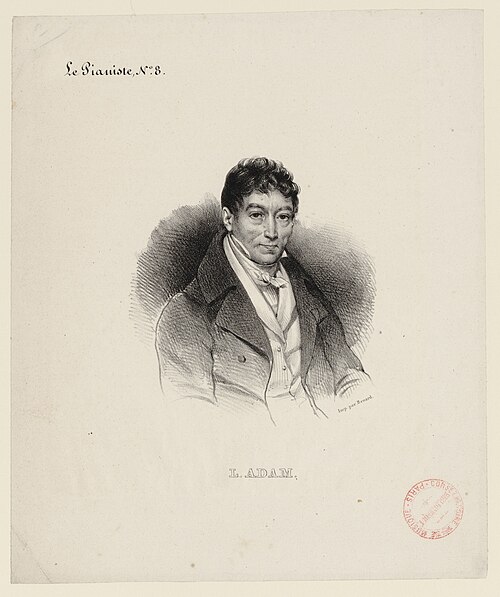

Louis Adam
1758 — 1848
Louis Adam or Jean-Louis Adam was a French composer, music teacher, and piano virtuoso.
Adapted from the Wikipedia article on Louis Adam.
From the period sources
Louis Adam, born in Alsatia in 1758, became a distinguished musician and eminent pedagogue in Paris, where he moved in 1775. He served as professor of pianoforte at the Paris Conservatoire from 1797 to 1843, during which time he was a close student of the German classic masters and an admirable pianist, according to A Biographical Dictionary of Musicians (1900). Adam’s influence as a teacher was significant, counting among his pupils such figures as Kalkbrenner, Hérold, Henri le Moine, and F. Chaulieu. He authored two standard instruction books for piano: “Méthode ou principe générale du doigté pour le Forte-piano” (1798) and “Méthode nouvelle pour le Piano” (1802-32), the latter written specifically for Conservatoire pupils and seeing five editions. His compositions, including numerous piano pieces, were popular in their day, notably his variations on “Le roi Dagobert” (A Biographical Dictionary of Musicians, 1900). Indeed, his “Méthode de Piano du Conservatoire” incorporated the celebrated Ranz des Vaches of Appenzell, a tune also used by Grétry in his Guillaume Tell Overture (Grove’s Dictionary, 1922). Adam’s son, Adolphe-Charles, would later succeed him as professor of composition at the Conservatoire after his father’s death in 1848 (A Biographical Dictionary of Musicians, 1900).