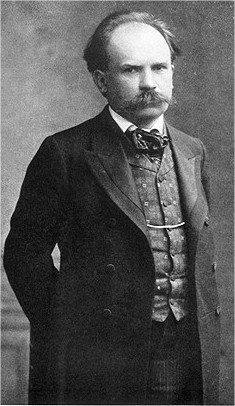

Eugen d' Albert
1864 — 1932
Eugen Francis Charles d’Albert was a Scottish-born pianist and composer who immigrated to Germany and later to Switzerland.
Adapted from the Wikipedia article on Eugen d’Albert.
From the period sources
Eugen d’Albert, born in Glasgow in 1864, was a distinguished pianist and gifted composer who adopted the German spelling of his first name. His father, Charles L. N. d’Albert, a musician and dancing-master known for popular dances, served as his first teacher (A Biographical Dictionary of Musicians, 1900). D’Albert’s early education included being elected Newcastle scholar at the National Training School in London in 1876, where he studied piano with Pauer and harmony and composition with Stainer, Prout, and Sullivan. In 1881, as a Mendelssohn scholar, he continued his studies under Richter in Vienna and Liszt in Weimar, with Liszt famously dubbing him “the young Tausig” due to his remarkable technique (A Biographical Dictionary of Musicians, 1900).
His public career began with a performance of Schumann’s concerto at the Crystal Palace in London on February 5, 1881, followed by a concerto of his own in A at a Richter Concert that October. D’Albert quickly achieved “full pianistic maturity,” notably performing five Beethoven sonatas at a Gewandhaus recital in 1893, a feat that, according to A Biographical Dictionary of Musicians (1900), “vied with Bülow’s famous programs.” His compositional output included two piano concertos, a symphony, two overtures, and several operas, such as Der Rubin (1893) and Ghismonda (1895), which received favorable or moderate success. He married the celebrated pianist Teresa Carreño in 1892, though they divorced in 1895, and later resided in Germany, briefly serving as first Kapellmeister at Weimar in 1895 (A Biographical Dictionary of Musicians, 1900).