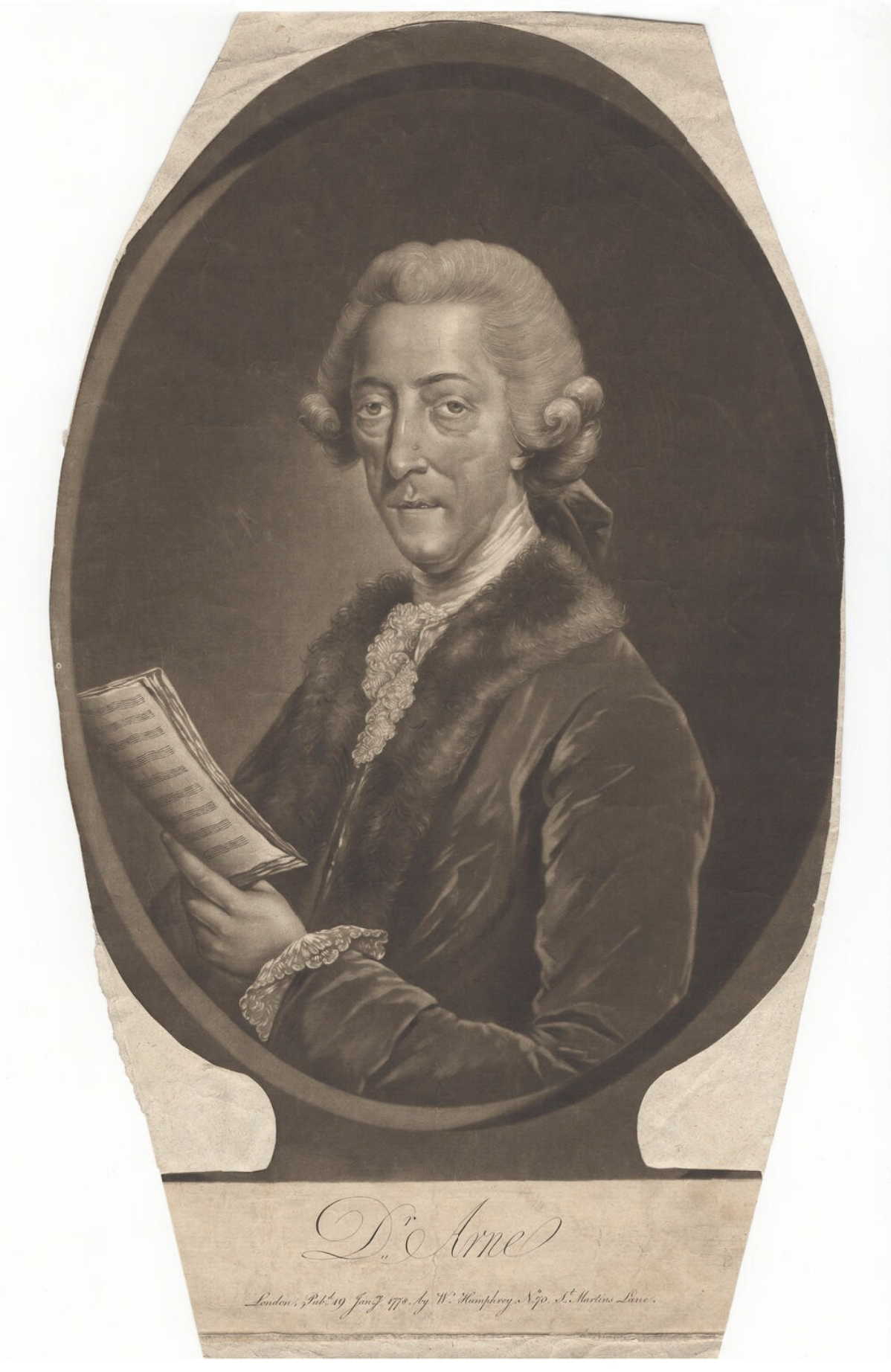

Thomas Augustine Arne
1710 — 1778
Thomas Augustine Arne was an English composer of the late Baroque and early Classical periods. He is known for his patriotic song “Rule, Britannia!” and the song “A-Hunting We Will Go”, the latter composed for a 1777 production of The Beggar’s Opera, which has since become popular as a folk song and a nursery rhyme. Arne was a leading British theatre composer of the 18th century, working at the West End’s Drury Lane and Covent Garden. He wrote many operatic entertainments for the London theatres and pleasure gardens, as well as concertos, sinfonias and sonatas.
Adapted from the Wikipedia article on Thomas Arne.
From the period sources
Thomas Augustine Arne, counted among the foremost English composers, cultivated his musical talents for spinet and violin through “stolen nightly practice” against his father’s initial wishes for him to pursue law, as recorded in A Biographical Dictionary of Musicians (1900). His family was deeply entrenched in the London musical scene; his sister, Suzanne-Marie Cibber, an excellent actress and singer, was taught music by Arne himself and debuted in one of his operas at the Hay-Market theatre, according to Biographie universelle des musiciens (1883). She was also a “prime favorite of Handel’s” and Handel composed one of the airs for his Messiah for her. In 1736, Arne married Cecilia Young, a fine singer and pupil of Geminiani.
Arne’s reputation was firmly established in 1738 as composer to the Drury Lane Theatre, and he is widely known as the composer of the celebrated “Rule Britannia,” found within his music for the masque Alfred (1740). He was also the first to introduce female voices into oratorio-choruses with his work Judith (1764), a performance for which Jonathan Battishill later served as cembalist at Covent Garden, having co-written the opera Almena with Arne in 1764, as noted in Dictionary of Music (1908). Arne lived continuously in London as a composer and concert-giver, with the exception of two years in Dublin, and was created Mus. Doc. (Oxon.) in 1759. His early setting of Addison’s opera Rosamond (1733) bore “considerable promise of his future excellence,” according to Grove’s Dictionary of Music and Musicians (1922).