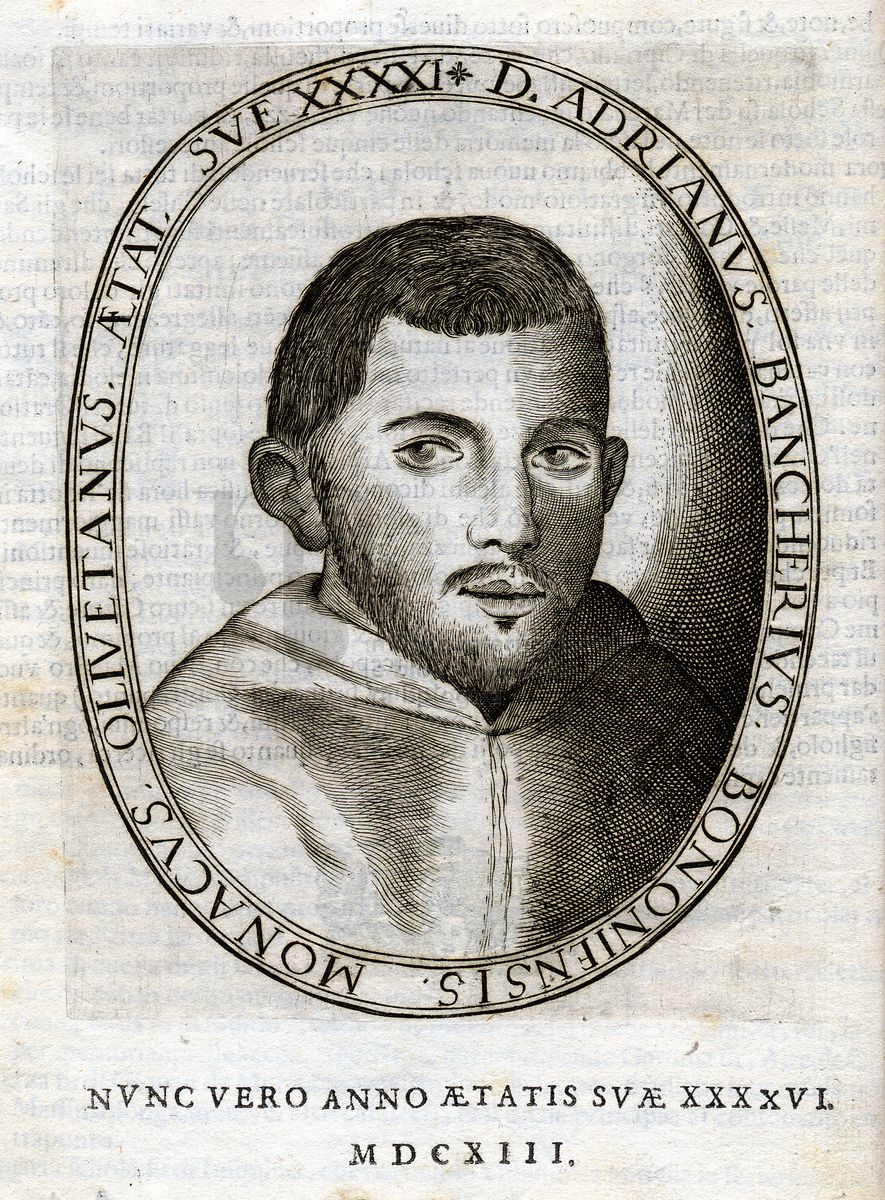

Adriano Banchieri
1568 — 1634
Adriano Banchieri was an Italian composer, music theorist, organist and poet of the late Renaissance and early Baroque eras. He founded the Accademia dei Floridi in Bologna.
Adapted from the Wikipedia article on Adriano Banchieri.
From the period sources
Adriano Banchieri, a pupil of organist Guami, held various posts as an organist, including at Santa Maria in Regola in Imola, and at San Michele in Bosco near Bologna, before becoming a “Monaco olivetano” at Monte Oliveto and eventually abbot there, according to Grove’s Dictionary (1904). He was considered a famous composer in his time, with many works preserved, encompassing church music, madrigals, and canzonets (Dictionary of Music, 1896). Banchieri was also a poet, writing comedies under the pseudonym Camillo Scaligeri della fratta (A Dictionary of Music and Musicians, 1879).
His theoretical contributions are particularly notable. His “L’Organo suonarino,” published in Venice in 1605, is described by A Dictionary of Music and Musicians (1879) as containing “the first precise rules for accompanying from a figured bass.” In his “Moderna practica musicale” (1613 or 1618), he discussed the influence of the basso continuo on vocal ornaments, though he found the contemporary changes in harmony and tonality “incomprehensible” (A Dictionary of Music and Musicians, 1879; Grove’s Dictionary, 1904). Banchieri’s “Concerti ecclesiastici” (1595) are cited as an early example of figured bass, alongside Peri’s Euridice (1600), predating Ludovico Viadana’s “Cento concerti… con il basso continuo” (1602), which was formerly credited with the invention of thorough-bass (A Biographical Dictionary of Musicians, 1900, 1905). He also contributed to the ongoing discussion of solmisation syllables, proposing “ba” for the seventh note in his “Cartella Musicale” (1610), as noted by Dictionary of Music (1896, 1908). Furthermore, Banchieri’s “Conclusioni nel suono dell’ organo” (1608) offers a historical claim regarding the spinet, stating that the instrument received its name from Giovanni Spinetti, a Venetian inventor of its oblong form, a claim he supported by having seen such an instrument dated 1503 (A Dictionary of Music and Musicians, 1883; Grove’s Dictionary, 1908; A Description and History of the Pianoforte, 1896). This work also mentions Girolamo Diruta, a celebrated organist, playing a “stupendissimo organo” at Gubbio Cathedral (Grove’s Dictionary, 1904). Banchieri was also a founder of the Accademia Florida, which met in Bologna around 1623 (Grove’s Dictionary, 1904).