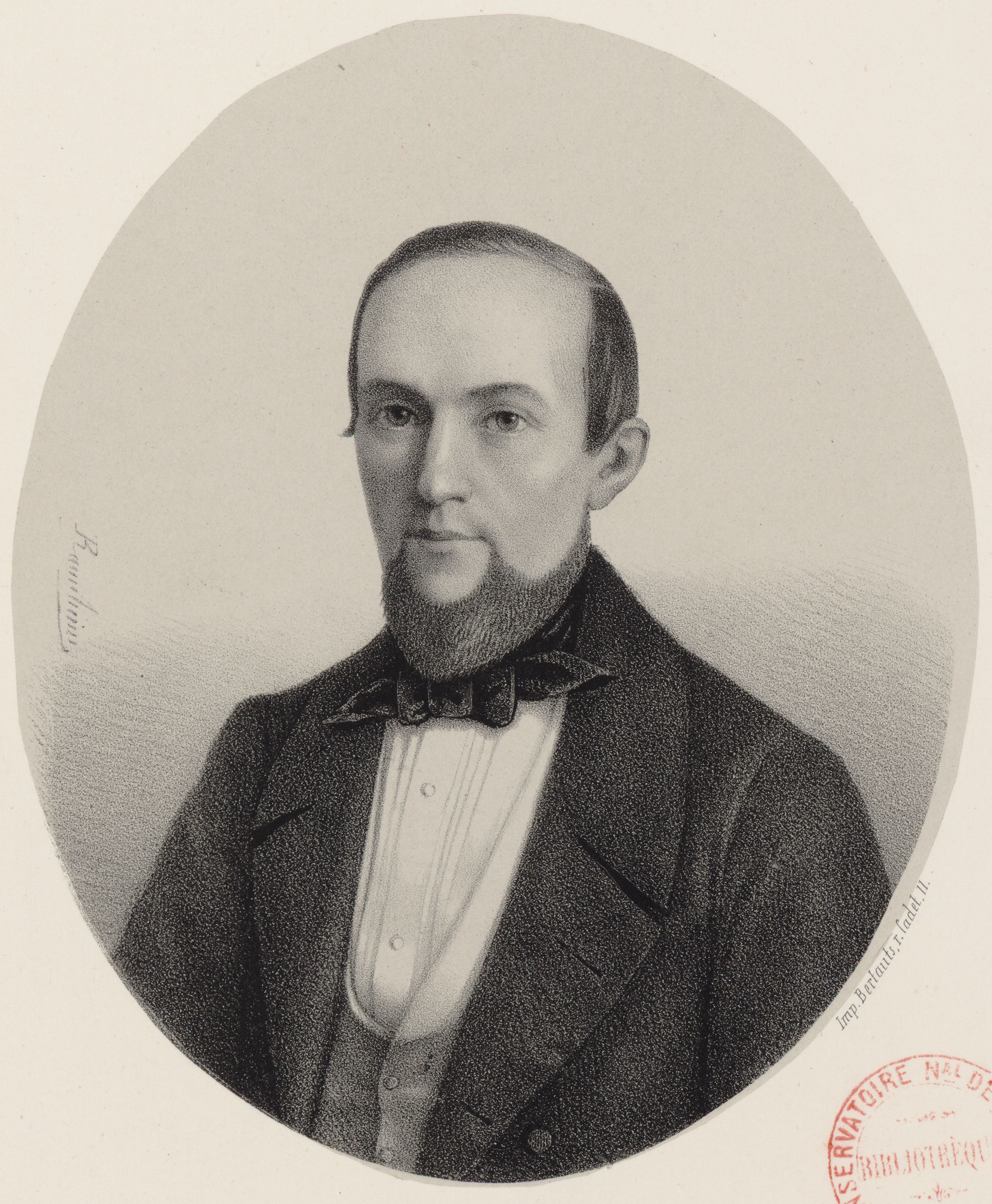

Jacques-Louis Battmann
1818 — 1886
Jacques-Louis Battmann was a 19th-century French organist and composer.
Adapted from the Wikipedia article on Jacques-Louis Battmann.
From the period sources
Jacques-Louis Battmann, born in Maasmunster, Alsatia, on August 25, 1818, initially pursued a path to become a teacher, studying at the college of Belfort and the École normale de Colmar (Biographie universelle des musiciens, 1880). Though he became an instructor, he later dedicated himself entirely to music, a passion he had cultivated since childhood. His earliest lessons in solfège, piano, and violin came from his maternal grandfather, an organist in Belfort, and he later studied harmony and composition with Th. Schlosser at the École normale, while also learning organ from Martin Vogt, the cathedral organist (Biographie universelle des musiciens, 1880). A chance meeting with the celebrated physician Orfila, a noted music amateur, nearly brought Battmann to the Paris Conservatoire, but he chose to remain after seeing his beloved teacher weep at the prospect of his departure. He eventually became an organist, first at Belfort in 1840, and later at Vesoul (A Biographical Dictionary of Musicians, 1900). Battmann was a prolific composer, publishing around 400 works, including masses, motets, and choral pieces, alongside numerous compositions and methods for both piano and harmonium, and a treatise on harmony for the accompaniment of Plain Song (Cyclopedia of Music and Musicians, 1888; Dictionary of Music, 1896).