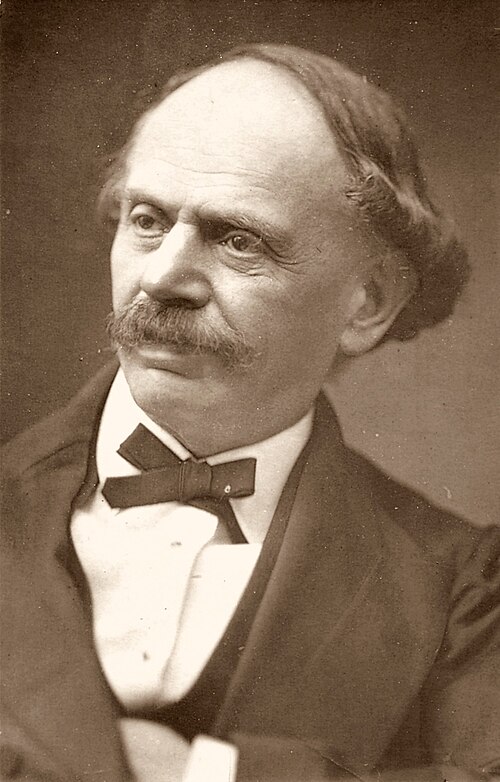

Julius Benedict
1804 — 1885
Sir Julius Benedict was a German-born composer and conductor, resident in England for most of his career.
Adapted from the Wikipedia article on Julius Benedict.
From the period sources
Sir Julius Benedict, born in Stuttgart in 1804 to a Jewish banker, studied with Abeille, Hummel in Weimar (1819), and Weber in Dresden (1820), according to A Biographical Dictionary of Musicians (1900). His early career saw him as Kapellmeister at Vienna’s Kärntnerthor Theatre in 1823 and Naples’ San Carlo Theatre in 1825, though his first operas, Giacinta ed Ernesto (1829) and I Portoghesi in Goa (1830), were not marked successes. After two visits to Paris, Benedict settled in London, becoming, as A Biographical Dictionary of Musicians (1905) notes, “thoroughly anglicized” and a fashionable piano teacher and concert-giver.
His conducting career in London was extensive, including opera buffa at the Lyceum in 1836, Drury Lane from 1837, and later for Colonel Mapleson at Her Majesty’s Theatre and Covent Garden from 1859. He also led the “Monday Popular Concerts” and several Norwich Festivals, as well as the Liverpool Philharmonic from 1876 to 1880. Benedict’s first English opera, The Gypsy’s Warning, was produced at Drury Lane in 1838, and The Lily of Killarney (1862) was particularly successful, running for over sixty performances in England and later performed in Germany as Die Rose von Erin (Biographie universelle des musiciens, Vol. 1, 1880). He was knighted in 1871, a distinction shared that year with Sir William Sterndale Bennett and Dr. Elvey (Biographie universelle des musiciens, Vol. 1, 1880). Benedict also accompanied Jenny Lind on her American tours in 1850 and 1851, and contributed a biographical sketch of Weber to Hueffer’s “Great Musicians” (Dictionary of Music, 1896).