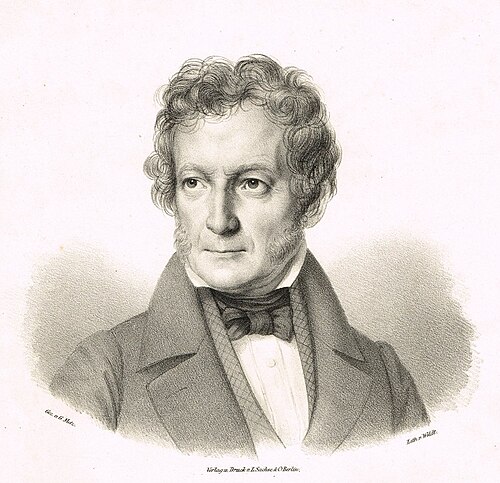

Ludwig Berger
1777 — 1839
Carl Ludwig Heinrich Berger was a German pianist, composer, and piano teacher. He was born in Berlin, and spent his youth in Templin and Frankfurt, where he studied both flute and piano. Later, he studied composition with Joseph Augustin Gürrlich in Berlin. He became a pupil of the composer Muzio Clementi, and went with him to Russia, where he stayed for eight years. While in Russia, he married, but was widowed in less than a year. During the Napoleonic Wars, he fled to London, where his piano performances were well received. He returned to Berlin in 1814, and lived there for the rest of his life. A nervous disorder in his arm led to the end of his career as a piano virtuoso, and he built a reputation as a teacher, numbering Felix and Fanny Mendelssohn, as well as Taubert, Dorn, and August Wilhelm Bach among his more distinguished pupils. See List of music students by teacher: A to B § Ludwig Berger.
Adapted from the Wikipedia article on Ludwig Berger (composer).
From the period sources
The German pianist and composer Ludwig Berger, born in Berlin in 1777, studied under Clementi, whose “stately legato style” he helped connect with the “more modern development of Hummel, Moscheles, and Chopin,” according to Brown’s Biographical Dictionary (1886). Berger practiced as a teacher in London from 1812 to 1815, before returning to Berlin, where he resided as a teacher and concert-giver until his death in 1839. His contemporaries acknowledged him as a foremost pianist and teacher, and his works, including a “Sonata pathétique” (Op. 1) and “Twelve studies” (Op. 11), were popular. Notably, Berger taught a number of musicians who achieved eminence, such as Mendelssohn, Taubert, and Henselt (Brown’s, 1886). He also taught the critic Karl Banck in Berlin between 1826 and 1829 (A Biographical Dictionary of Musicians, 1900), and was a piano instructor to Henri Dorn (Biographie universelle des musiciens, Vol. 3, 1837) and Elisabeth Tautmann Brendel (Biographie universelle des musiciens, Vol. 2, 1857). Berger was also a co-founder of the ‘jüngere Liedertafel’ singing society in 1819 (Grove’s Dictionary, 1922). Ludwig Rellstab published a memorial, “Ludwig Berger, ein Denkmal,” in Berlin in 1846 (Cyclopedia of Music and Musicians, Vol. 1, 1888).