
A guide to
Joseph Bonnet
Bordeaux 1884 — Sainte-Luce-sur-Mer, Quebec 1944
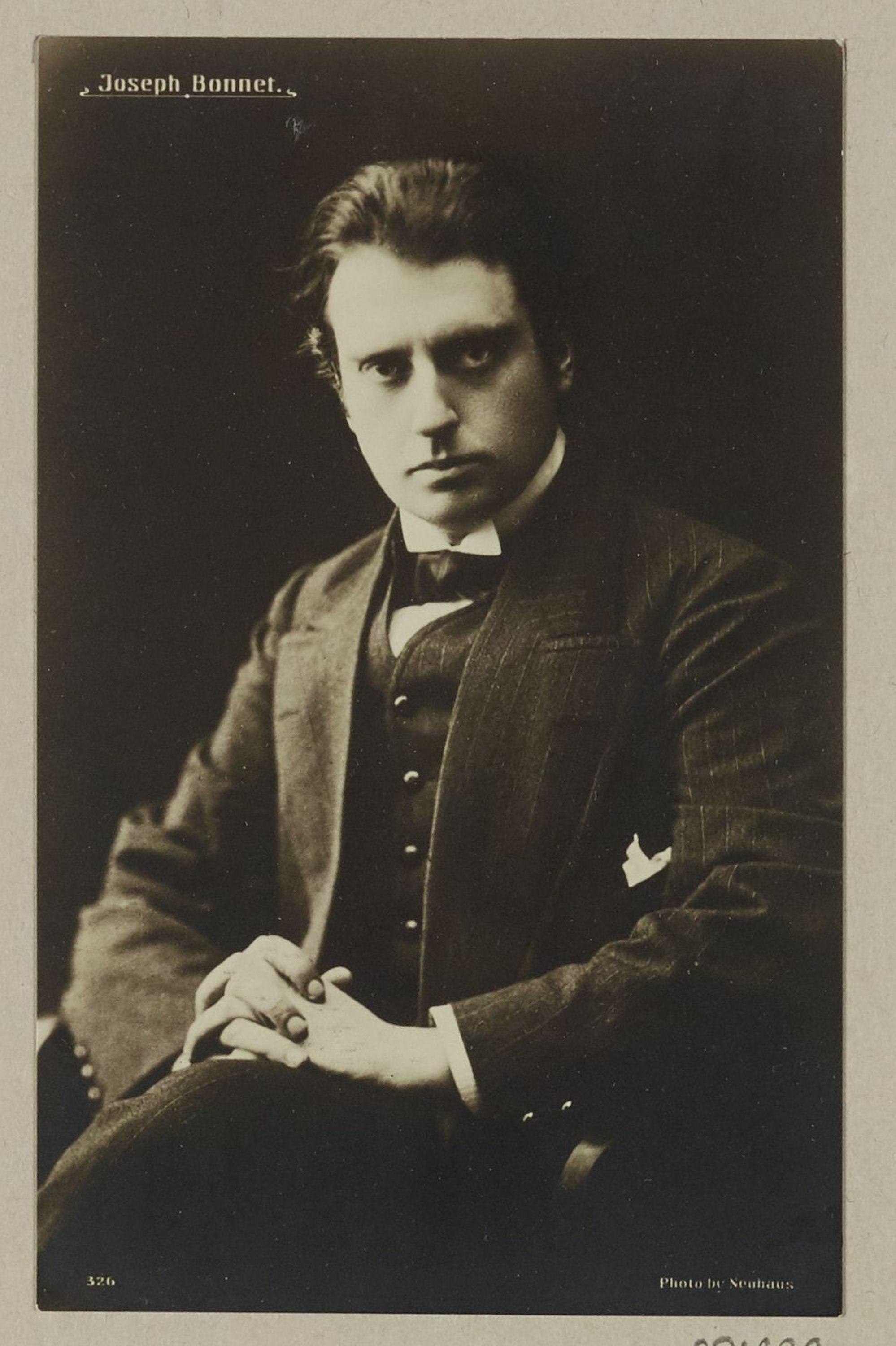
Joseph Élie Georges-Marie Bonnet was a French organist of the generation after Widor and Guilmant — a brilliant recitalist who carried the French organ tradition across the Atlantic, a meticulous scholar who dug its forgotten ancestors out of the libraries, and a composer of polished concert pieces for his own instrument. He was born in Bordeaux on 17 March 1884, the son of an organist at the church of Sainte-Eulalie, and he was playing church services himself while still a boy. His talent took him to Paris and into the organ class of Alexandre Guilmant at the Conservatoire, from which he emerged with a first prize.
In 1906 he won the post of organist at Saint-Eustache, one of the great churches of Paris, with its enormous instrument. Five years later, in 1911, he succeeded his teacher Guilmant as the official concert organist of the Conservatoire — a quiet confirmation that the line of Guilmant and the French symphonic school had a worthy heir.
The travelling virtuoso
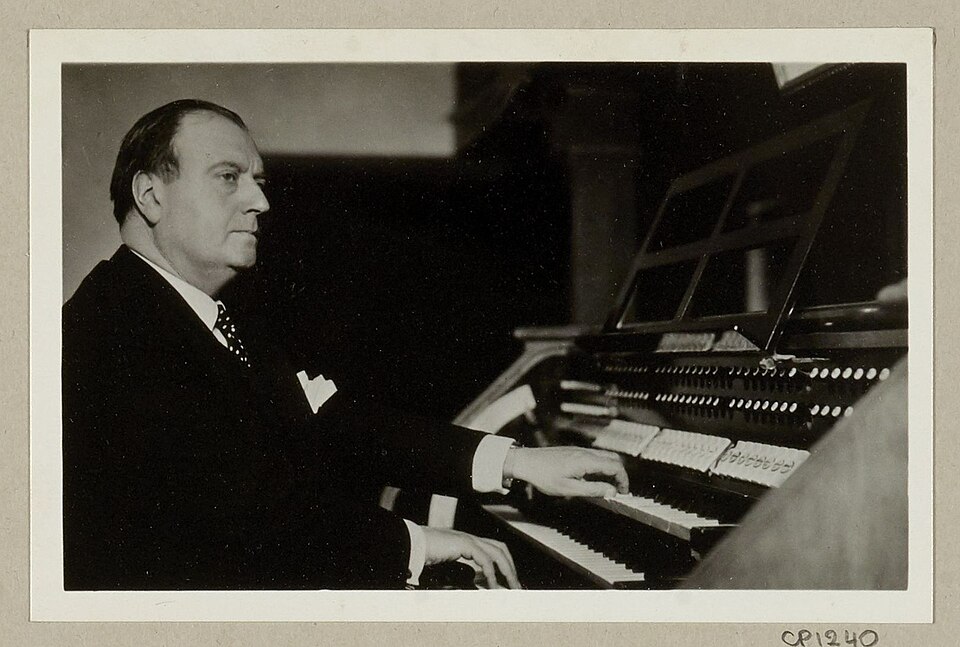
What set Bonnet apart from the Paris organ loft was his appetite for travel. From January 1917 he undertook an American tour of more than a hundred recitals, playing across the United States and Canada and introducing audiences there to the full sweep of the French and European organ literature. The connection took root: in 1921 he founded the organ department at the Eastman School of Music in Rochester, planting the French school in American soil.
He never fully left North America behind, and when the Second World War overtook France he crossed the Atlantic again for good. In 1940 he left France, taught in the United States and then in Quebec, and it was in Canada — at Sainte-Luce-sur-Mer on the St Lawrence — that he died on 2 August 1944, far from the Paris organ lofts where he had made his name.
Scholar of the old repertoire
Bonnet’s most enduring contribution may not be his own compositions at all. His Historical Organ-Recitals — a multi-volume anthology of early organ music — gathered up the neglected French, Italian and German masters of earlier centuries and put them back into the hands of modern players. In an age when organists tended to play mostly their contemporaries, this was an act of recovery as much as of scholarship, and it shaped recital programmes for decades.
His own works are fewer and, characteristically, written for the recital hall. The Variations de Concert, Op. 1, is the piece that still appears on programmes: a virtuoso set of variations that displays the player and the instrument together. Alongside it stand three sets of 12 Pièces (Opp. 5, 7 and 10), character pieces in the warm, post-Romantic French idiom — devotional, picturesque, and grateful to play. Listen for the way Bonnet writes for the organ as a colourist, choosing each stop the way a painter chooses a pigment — the inheritance of the great French symphonic builders, carried to a new continent.