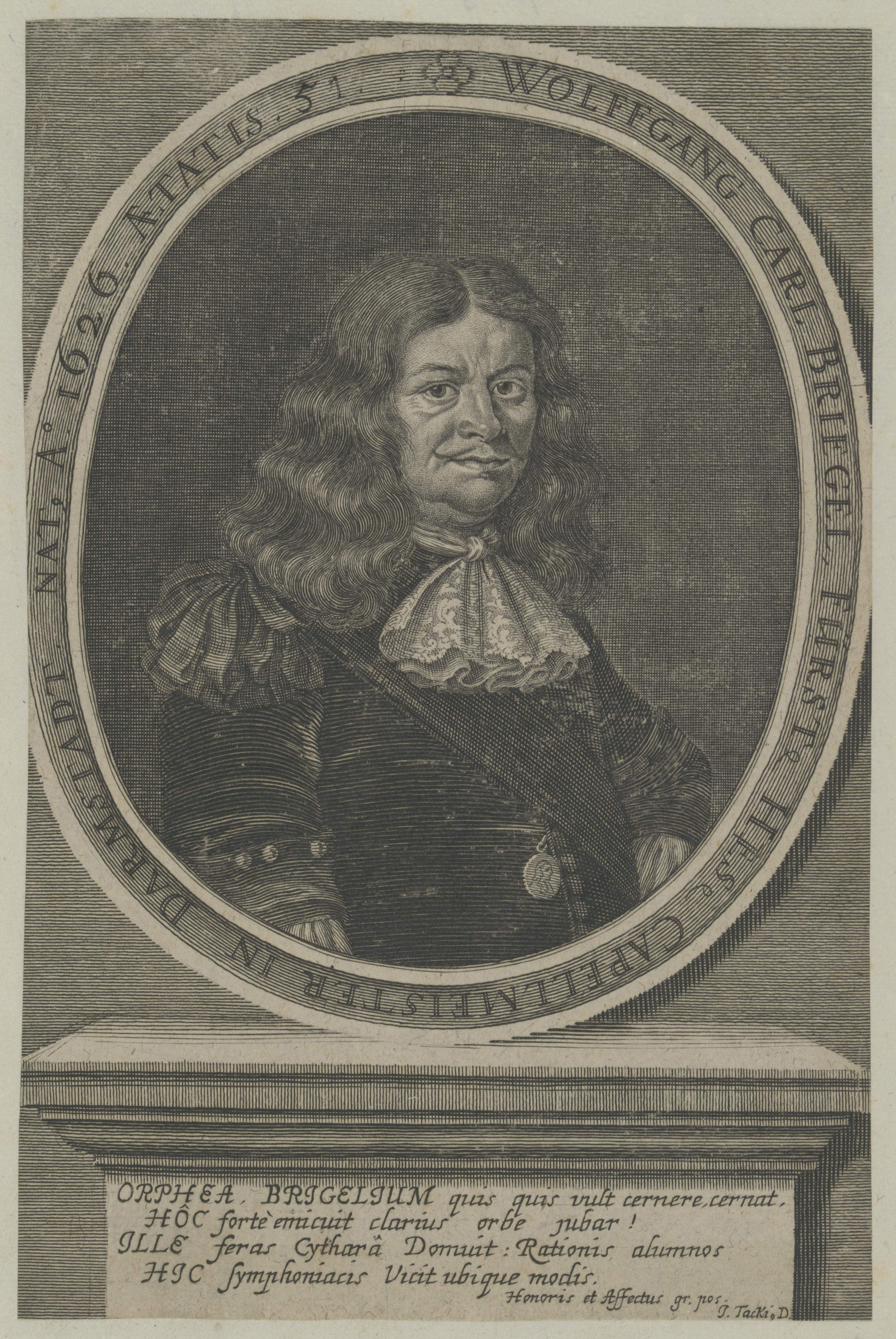

Wolfgang Carl Briegel
1626 — 1712
Wolfgang Carl Briegel was a German organist, teacher and composer.
Adapted from the Wikipedia article on Wolfgang Carl Briegel.
From the period sources
Wolfgang Carl Briegel, born in Germany in 1626, began his career as an organist at Stettin before being called to Gotha around 1651 to serve as cantor, a position he held for two decades (Biographie universelle des musiciens, 1883). In 1660, he became music director to the Duke of Saxe-Gotha, and by 1670, he was appointed Kapellmeister to the Landgrave of Darmstadt, where he remained until his death in 1710 or 1712 (Biographical Dictionary of Musicians, 1886; Dictionary of Music, 1896). Briegel was a remarkably prolific composer, producing a vast array of works for the Protestant church and instrumental pieces, including concertos, sonatas, madrigals, dance music, and psalms, published between 1652 and 1709 (Biographie universelle des musiciens, 1883; Cyclopedia of Music and Musicians, 1888). His output included sacred songs, many to his own words, and a secular work titled “Musikalisches Tafel-Confect,” described as “pleasant Conversations and Concertos” (A Dictionary of Music and Musicians, 1879). Christoph Graupner, who succeeded Briegel as Kapellmeister at Darmstadt, was promoted to the post upon Briegel’s death (Grove’s Dictionary, 1906). A portrait of Briegel, engraved by Nessenthaler when the composer was about sixty-five, depicts him as a man of “healthy and jovial aspect, and with no trace of the labour involved in so many serious compositions” (A Dictionary of Music and Musicians, 1879).