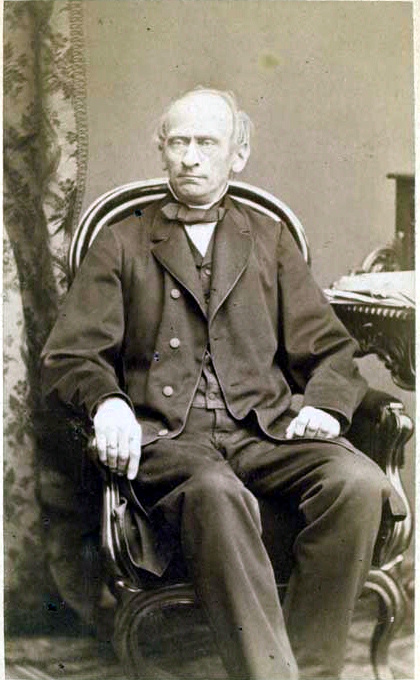

Moritz Brosig
1815 — 1887
Moritz Brosig was a German cathedral organist and composer. He came to be seen as a leading representative of the so-called Breslau School of church musicians. Despite his Roman Catholic faith, he wrote more than thirty chorale preludes, working in a musical genre more traditionally associated with Lutheran worship.
Adapted from the Wikipedia article on Moritz Brosig.
From the period sources
Moritz Brosig, described as a “prolific church-composer” by A Biographical Dictionary of Musicians (1900), was born in Fuchswinkel, Upper Silesia, in 1815. He received his musical training in Breslau, studying with Franz Wolf, the cathedral organist and musical director, whom he succeeded in his posts in 1842. Brosig’s career saw him rise to cathedral Kapellmeister in 1853, and he was later awarded an honorary Doctor of Philosophy degree, becoming assistant director of the Royal Institute for Catholic Church Music and a university lecturer, as well as a member of the “Cecilia” Academy at Rome (Dictionary of Music, 1896). His influence extended through his teaching, with notable pupils including the pianist and composer Salomon Jadassohn, who studied harmony under Brosig, and Robert Radecke, who studied composition with him (Biographical Dictionary of Musicians, 1886). Brosig also taught Konstantin Bürgel and the distinguished musicologist Robert Eitner, who later founded a piano school in Berlin (Cyclopedia of Music and Musicians, Vol. 2, 1889; The New Encyclopedia of Music and Musicians, 1924). Brosig’s extensive output included four grand and three short instrumental masses, seven books of graduals and offertories, and twenty books of organ pieces, alongside theoretical works such as his “Modulationstheorie” and “Harmonielehre” (1874).