A guide to
Nicolaus Bruhns
Schwabstedt, Schleswig 1665 — Husum 1697
Nicolaus Bruhns was the most gifted pupil of Dieterich Buxtehude, and the great might-have-been of the North German organ school. He was a brilliant organist, a virtuoso violinist, and a composer of fierce originality — and he died at about thirty-one, leaving barely a dozen vocal works and a handful of organ pieces. On the strength of those few survivals he is counted among the masters; the larger of his two E minor preludes is routinely named one of the finest organ works the school ever produced. What he might have written had he lived as long as his teacher is one of music’s open questions.
He was born in Schwabstedt, in Schleswig, late in 1665, into a dynasty of musicians — his grandfather a lutenist at the Gottorf court, his father an organist, his uncle a string teacher in Lübeck. At about sixteen he was sent to Lübeck, where he lived with that uncle and learned the violin and viol, and where he studied organ and composition with Buxtehude, who came to regard him as his finest student and eventually sent him out into the world with the warmest recommendation.
The violin in the organ loft
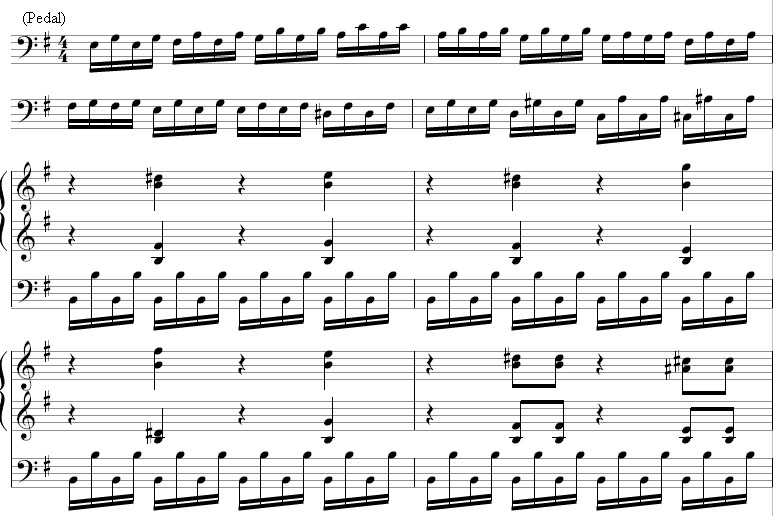
The one vivid story we have of Bruhns at work comes from Johann Mattheson’s Grundlage einer Ehren-Pforte (Hamburg, 1740), the great biographical dictionary that preserves so much of this generation. Bruhns, Mattheson reports, was so accomplished a violinist that he would sometimes carry his instrument up to the organ loft and play it alone, “as if there had been three or four of them,” while his feet supplied a fitting bass on the organ pedals — one man conjuring a small consort from a violin and his own two feet. It is the kind of feat that explains the restless, multi-voiced energy of his organ writing.
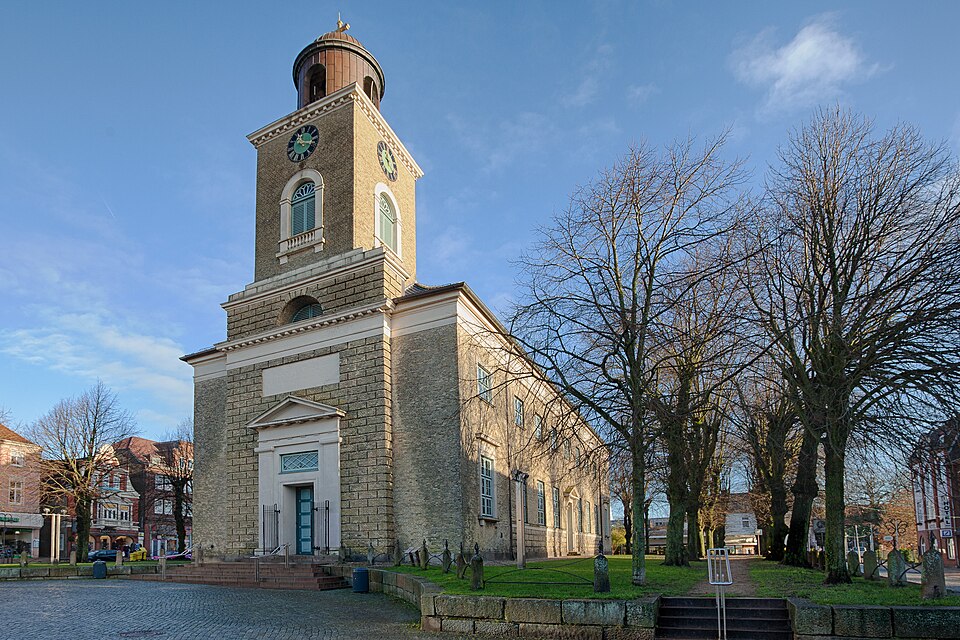
After Lübeck he worked for a time in Copenhagen as organist and violinist, broadening his style through contact with Italian musicians, before returning south. In 1689 he competed for the post of organist at the town church in Husum and was unanimously appointed on 29 March. So highly was he valued that when the city of Kiel tried to lure him away, Husum simply raised his salary to keep him — again a detail we owe to Mattheson.
A career cut short
Bruhns held the Husum post for only eight years. He died there on 8 April 1697, aged about thirty-one, and was succeeded by his younger brother Georg. The catastrophe for posterity is how little survives: around twelve sacred vocal works — concertos and cantatas that bring an almost Italian virtuosity to the German tradition — and only a small group of organ pieces: the two Praeludia in E minor (the “Great” and the “Little”), a Praeludium in G major, and the chorale fantasia Nun komm, der Heiden Heiland.
Yet within that tiny output the quality is astonishing. The organ preludes are masterpieces of the stylus phantasticus — the “fantastical style” of sudden gestures, dramatic pauses and brilliant fugue, the manner Bruhns inherited from Buxtehude and pushed to its limit. Bach himself, according to the obituary (Nekrolog) of 1754, took the keyboard works of Bruhns among his early models. For a composer who died so young, with so little to show, that is a remarkable place in the line that runs to the greatest of them all.