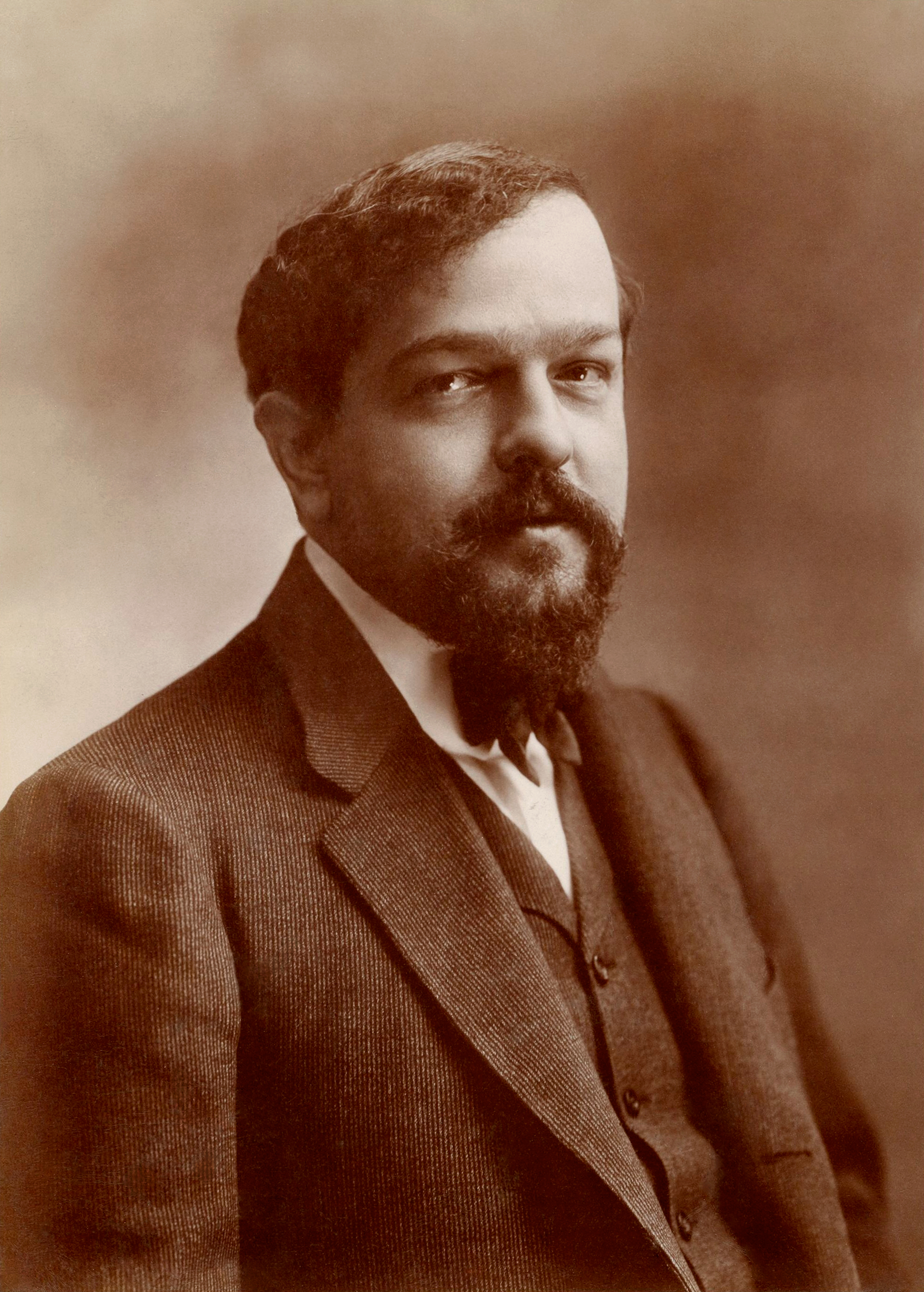

Claude Debussy
1862 — 1918
Achille Claude Debussy was a French composer, born in Saint-Germain-en-Laye. He is sometimes seen as the first Impressionist composer, although he vigorously rejected the term. He was among the most influential composers of the late 19th and early 20th centuries.
Adapted from the Wikipedia article on Claude Debussy.
From the period sources
Claude Debussy, a pupil of Guiraud at the Paris Conservatoire, won the prestigious prix de Rome in 1884 with his cantata L’Enfant prodigue, a work Grove’s Dictionary of Music and Musicians (1904) considered “one of the most remarkable of modern student-exercises.” However, his subsequent cantata, La Demoiselle elue, was “rejected by the Academie as ultra-modern in tendency,” according to A Biographical Dictionary of Musicians (1905). This rebuff did not deter him, as he continued in the same path with works like the symphonic poem “l’Apres-midi d’un faune” and the lyric drama Pelléas et Mélisande, which premiered in Paris in 1902. The latter’s “originality and independence of the conception” and “unusual harmonic progressions” sparked much discussion, making it “the most important of recent musical events in Paris,” as noted by Grove’s (1904). Grove’s Dictionary (1908) also observed that the “free declamation” in Pelléas et Mélisande shared much with recitative. His style, characterized by “subtle and dreamy impressionism,” was contrasted with the “clear objective outlook” of Rimsky-Korsakov by Grove’s (1922). Debussy’s works, including piano pieces like “Estampes” (1903) and “Images,” were published by A. Durand et Fils, a firm also known for Saint-Saëns and Franck, as Grove’s (1904) records.