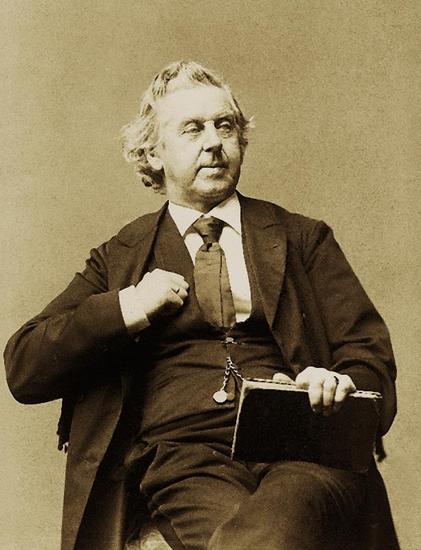
.jpg)
Niels Gade
1817 — 1890
Niels Wilhelm Gade was a Danish composer, conductor, violinist, organist and teacher. Together with Johan Peter Emilius Hartmann, he was the leading Danish musician of his day, in the period known as the Danish Golden Age.
Adapted from the Wikipedia article on Niels Gade.
From the period sources
Niels Gade, a Danish composer, first garnered attention with his “Ossian” overture, for which he received a prize from the Musical Union of Copenhagen in 1841, according to the Cyclopedia of Music and Musicians (1890). His popularity initially blossomed in Germany, where his first symphony was produced under Mendelssohn’s direction at the Leipzig Gewandhaus, making his name widely known (Famous Composers and Their Works, 1891). Mendelssohn himself, after rehearsing Gade’s Symphony in C minor in January 1843, was “extremely interested” and sent the “distant and unknown composer” a letter “full of sympathy and encouragement,” as Grove’s Dictionary (1904) records. The symphony premiered to “extraordinary applause” in March of that year. Gade later became associated with Mendelssohn as a conductor of the Gewandhaus concerts, and in the winter of 1844, he played viola in the first public performance of Schumann’s Pianoforte Quartet (op. 47) at the Gewandhaus, while directing the concerts (Grove’s Dictionary, 1908). Robert Schumann, a contemporary, characterized Gade with “conspicuous talent” in his critiques, penetrating “to the core of their natures” with “delicate and picturesque manner” (Grove’s Dictionary, 1908). Though influenced by Mendelssohn and Schumann, Gade’s “Danish nationality comes to light in his works,” which are described as “truly poetical and vigorous” (Famous Composers and Their Works, 1891).