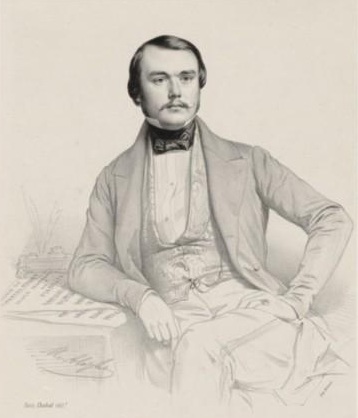

Alexandre Édouard Goria
1823 — 1860
Alexandre Édouard Goria was a French virtuoso pianist and composer of salon pieces.
Adapted from the Wikipedia article on Alexandre Goria.
From the period sources
Alexandre Édouard Goria, born in Paris in 1823, was a French pianist and composer who enjoyed a successful career as a teacher and a writer of popular drawing-room pieces until his death in 1860, according to Grove’s Dictionary of Music and Musicians (1906). He was a pupil at the Conservatoire from 1830 to 1839, studying pianoforte with Laurent and Zimmerman, and harmony with Dourlen. He earned the second prize for pianoforte in 1834 and the first prize in 1835, as detailed in the Cyclopedia of Music and Musicians (1889). After leaving the Conservatoire, Goria taught pianoforte and composed approximately one hundred pieces for the instrument, including caprices, nocturnes, and solos de concert. His output included a “great quantity of popular Pf. music,” such as his “Bluette” (Op. 1), “Harmonic du soir, nocturne” (Op. 2), and numerous mazurkas and studies, with his Op. 63, “Ecole moderne de Pianiste,” noted as “extremely useful works” by the Biographical Dictionary of Musicians (1886). He was also known for his transcriptions from operas and a fantasia on Schubert’s “Des Mädchen’s Klage,” which the Cyclopedia of Music and Musicians (1889) identifies as one of his best compositions. Goria’s style, characterized by “elegant and effective” drawing-room pieces, was influenced by Thalberg, placing him among those who brought “manual execution into the foreground,” as noted in Famous Composers and Their Works (1891).