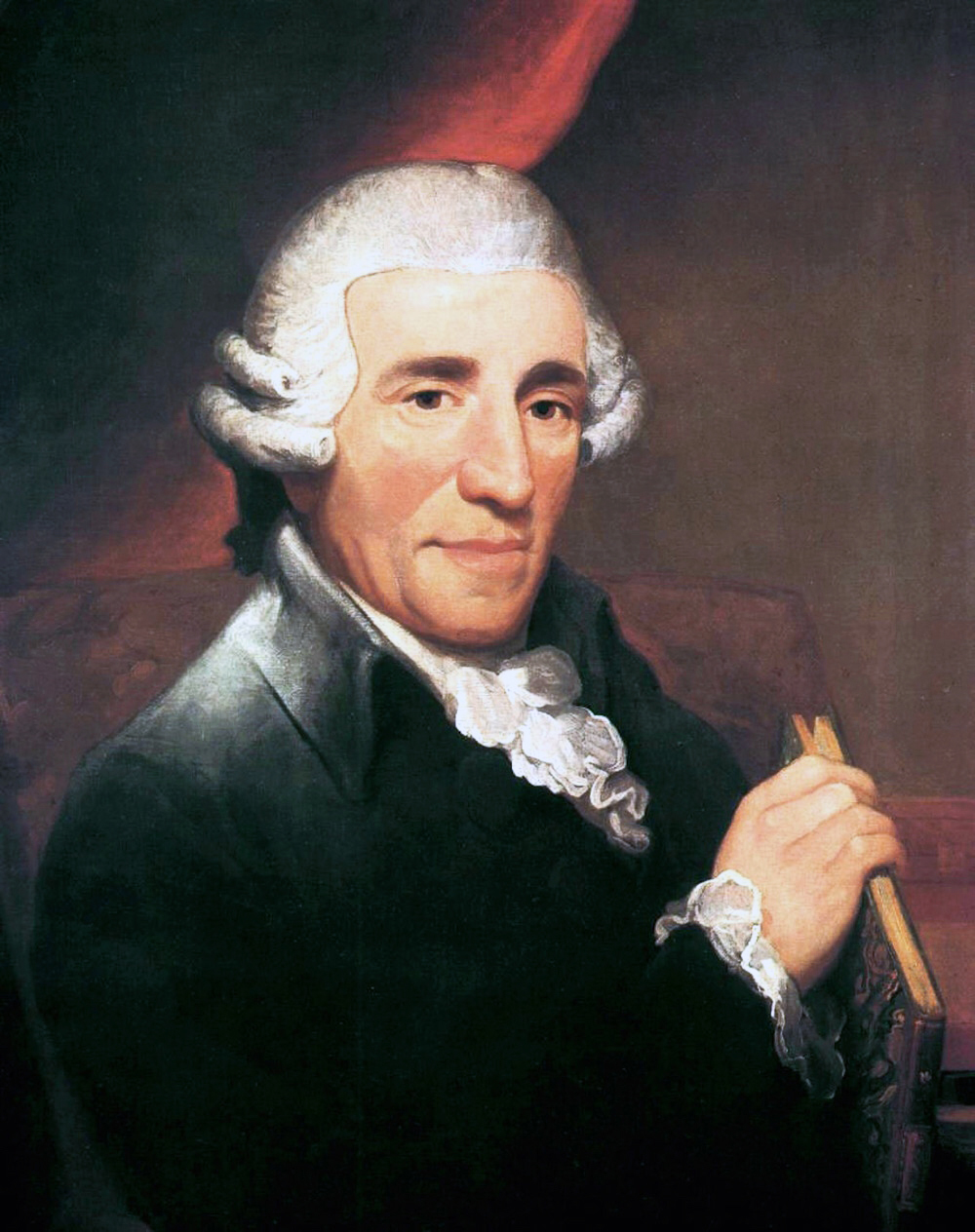

Joseph Haydn
1732 — 1809
Franz Joseph Haydn was an Austrian composer of the Classical period. He was pivotal in the evolution of chamber music forms like the string quartet and piano trio. His contributions to musical form have led him to be called “Father of the Symphony”, “Father of the String quartet” and “Father of Sonata form”.
Adapted from the Wikipedia article on Joseph Haydn.
From the period sources
Joseph Haydn’s influence on the development of musical forms was widely acknowledged by his contemporaries and later writers. Karl Philipp Emanuel Bach, for instance, was considered the “originator of the sonata- and symphony-forms, later perfected by Haydn, Mozart, and Beethoven,” according to A Biographical Dictionary of Musicians (1900). Haydn also played a pivotal role in the string quartet, with Grove’s Dictionary of Music and Musicians (1922) declaring him the “father” of the form as it was then understood. While his early quartets were deemed “sadly feeble” with “awkward” joints, his “incessant practice in symphonic composition” led to “vast progress” in his later works.
His fame drew the attention of biographers, with Ignaz Ernst Ferdinand Arnold, a lawyer, publishing sketches of Haydn in 1803, later collected in his Galerie der berühmtesten Tonkünstler des 18. u. 19. Jahrhunderts (1816). Joseph Carpani, who had personal “liaisons” with Haydn, published a volume of biographical and critical letters titled Le Haydine (1812), which included an Italian version of Haydn’s The Creation. This work was later plagiarized in French, prompting Carpani to publicly reclaim authorship, as recorded in Biographie universelle des musiciens et bibliographie générale de la musique, Vol. 3 (1837). Haydn’s compositions were published by prominent houses like Domenico Artaria in Vienna and Augener & Co. in London, and his quartets were even arranged for pianoforte by J. Louis Adam, a professor at the Paris Conservatoire, according to Biographical Dictionary of Musicians (1886).