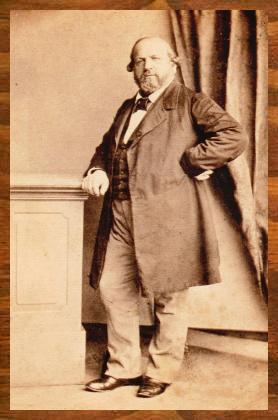

Ferdinand Hiller
1811 — 1885
Ferdinand (von) Hiller was a German composer, conductor, pianist, writer and music director.
Adapted from the Wikipedia article on Ferdinand Hiller.
From the period sources
Ferdinand Hiller was a composer, conductor, and virtuoso, whose influence extended across Europe. He was a respected teacher of composition at the Cologne Conservatory, where Charles Ainslie Barry studied under him (Brown’s Biographical Dictionary, 1886). Hiller was also a literary figure, publishing Moritz Hauptmann’s correspondence with Spohr and other composers in 1870, and a “charming book” on Mendelssohn, Félix Mendelssohn-Bartholdy, Lettres et souvenirs (Fétis, 1880). His own compositions included operas like Les Catacombes (1862) and Le Déserteur (1865), which saw success in Germany, alongside symphonies, oratorios, and chamber music (Fétis, 1880). In 1871, Hiller spent a season in London, performing as composer, conductor, and virtuoso, and was commissioned to write a significant work for the opening of the International Exhibition, representing Germany alongside Gounod, Pinsuti, and Sullivan (Fétis, 1880). He was also known for his “Rhythmische Studien,” op. 52, which featured quintuple rhythm, a rare meter also found in Handel and Chopin (Grove’s Dictionary, 1922).