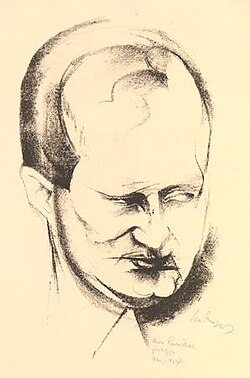

Paul Hindemith
1895 — 1963
Paul Hindemith was a German and American composer, music theorist, teacher, violist, and conductor. He founded the Amar Quartet in 1921, touring extensively in Europe. As a composer, he became a major advocate of the Neue Sachlichkeit style of music in the 1920s, with compositions such as Kammermusik, including works with viola and viola d’amore as solo instruments in a neo-Bachian spirit. His other notable compositions include the song cycle Das Marienleben (1923), the oratorio Das Unaufhörliche (1931), Der Schwanendreher for viola and orchestra (1935), the opera Mathis der Maler (1938), and the symphony Mathis der Maler (1934), the Symphonic Metamorphosis of Themes by Carl Maria von Weber (1943), and the oratorio When Lilacs Last in the Dooryard Bloom’d (1946), a requiem based on Walt Whitman’s poem. Hindemith and his wife emigrated to Switzerland and the United States ahead of World War II, after worsening difficulties with the Nazi German regime. In his later years, he conducted and recorded much of his own music.
Adapted from the Wikipedia article on Paul Hindemith.
From the period sources
Paul Hindemith, described as a “Gifted Hessian violinist and composer” by The New Encyclopedia of Music and Musicians (1924), received his training as a pupil of the Hoch Conservatory in Frankfort. By 1915, he had already become concertmaster at the Frankfort Opera. His early compositions included a piano-quintet, three string-quartets, and sonatas for violin, viola, and cello. He also composed the song-cycles Melancholie (with string-quartet) and Die junge Magd. His operatic work began to gain notice with three one-act operas given at Stuttgart in 1921, specifically Mörder and Nusch-Nuschi, followed by Sancta Susanna, which premiered in Frankfort in 1922. His brother, Rudolf Hindemith, born in 1900, was also a notable musician, known as a cellist, serving as soloist for the Munich Konzertverein from 1919 and at the Vienna Opera since 1921.