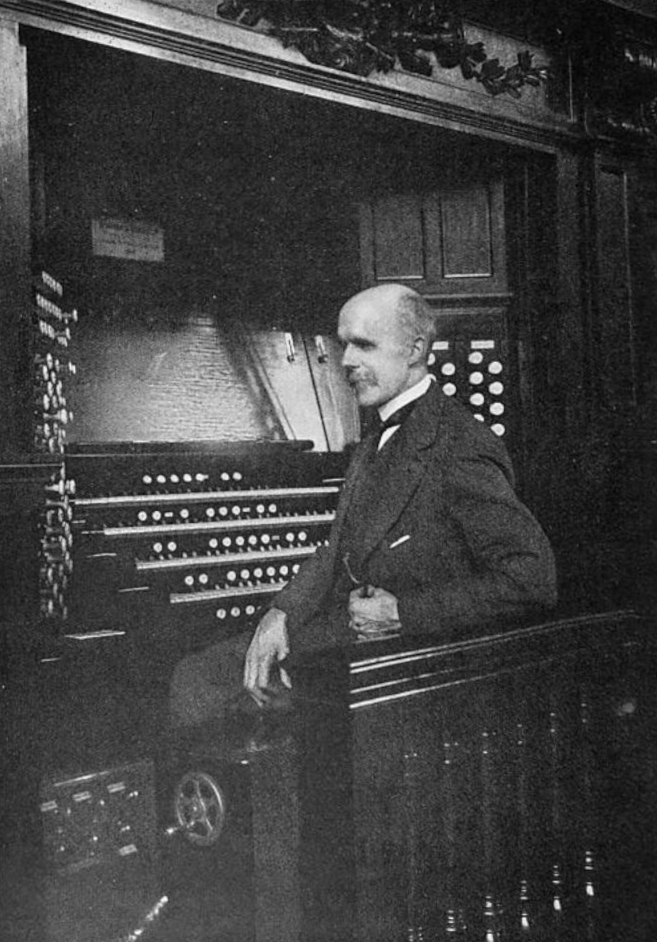
.png)
Alfred Hollins
1865 — 1942
Alfred Hollins was an English organist, composer and teacher, who was noted as a recitalist in Scotland.
Adapted from the Wikipedia article on Alfred Hollins.
From the period sources
Alfred Hollins, born in Hull in 1865, was a distinguished blind organist and pianist, noted by Grove’s Dictionary (1906) as a “remarkable example of the attainment of great proficiency in spite of total blindness.” He received early instruction from relatives before attending the Wilberforce Institution for the Blind at York, and later the Royal Normal College for the Blind at Upper Norwood, where he studied piano with Frits Hartvigson and organ with Dr. E. J. Hopkins. His talent was evident from a young age; he played Beethoven’s E-flat concerto at the Crystal Palace under Manns’s direction as “quite a boy,” and performed for Queen Victoria at Windsor at sixteen (Grove’s Dictionary, 1906).
Hollins further honed his skills with Hans von Bülow in Berlin and at the Raff Conservatorium in Frankfort. His career included performances before the King and Queen of the Belgians and the Empress Frederick, and he made his first appearance at a Philharmonic Concert in 1888 (Grove’s Dictionary, 1904). He toured the United States in 1886 and 1888, and Australia in 1894 and 1904, creating “great enthusiasm by his wonderful skill” during his Australian recitals (Grove’s Dictionary, 1906). By 1908, he was organist of St. George’s Free Church, Edinburgh, a post he took in 1897 when the organ was first introduced there. His compositions, including concert overtures, organ pieces, and songs, were praised for “sound musicianship, and no little originality,” and were described as “eloquent and vividly full of vigour and feeling” (Grove’s Dictionary, 1906).