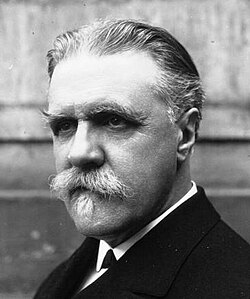

Vincent d' Indy
1851 — 1931
Paul Marie Théodore Vincent d’Indy was a French composer and teacher. His influence as a teacher, in particular, was considerable. He was a co-founder of the Schola Cantorum de Paris and also taught at the Paris Conservatoire. His students included Albéric Magnard, Albert Roussel, Arthur Honegger, Darius Milhaud, Yvonne Rokseth, and Erik Satie, as well as Cole Porter.
Adapted from the Wikipedia article on Vincent d’Indy.
From the period sources
Vincent d’Indy, born in Paris in 1851, was a composer and pianist who became a significant figure in French music. He studied composition with César Franck and organ at the Conservatory from 1873 to 1875, later becoming a chorus-master under Colonne in 1875 (A Biographical Dictionary of Musicians, 1900). To gain practical experience in orchestral detail, d’Indy notably “played orchestral drum-parts for 3 years” (Dictionary of Music, 1896). His early works included the second part of his symphonic poem “Wallenstein,” titled “I Piccolomini,” which Pasdeloup produced in 1874 (A Biographical Dictionary of Musicians, 1900).
D’Indy was a pupil of several notable teachers, including Marmontel for piano, who taught many prominent musicians such as Bizet (A Biographical Dictionary of Musicians, 1900). He was also a devoted disciple of César Franck, whose opera Ghiselle d’Indy helped complete after Franck’s death (Grove’s Dictionary, 1904). In 1896, d’Indy co-founded the Schola Cantorum in Paris with Charles Bordes and Alexandre Guilmant, an institution dedicated to the revival of plain-song and music from the Palestrina period. By 1900, this school had grown to over 300 pupils, with d’Indy serving as its head, directing monthly concerts that introduced students to works rarely heard elsewhere in Paris, including over twenty Bach cantatas and operas by Gluck and Monteverde (Grove’s Dictionary, 1908). While his 1882 comic opera Attendez-moi sous l’orme met with “slight success,” his three-act musical drama Fervaal, for which he wrote both text and music, was “successfully prod[uced] at Brussels in 1897” (A Biographical Dictionary of Musicians, 1900). He was recognized as a Chevalier of the Legion of Honor and a music inspector for Paris schools (A Biographical Dictionary of Musicians, 1900).