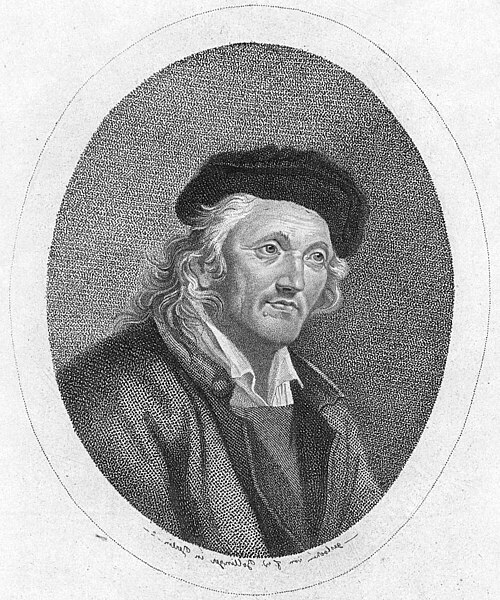

Johann Philipp Kirnberger
1721 — 1783
Johann Philipp Kirnberger was a musician, composer and music theorist. He studied the organ with Johann Peter Kellner and Heinrich Nicolaus Gerber, and starting in 1738 he studied with the violinist Meil in Sondershausen, but most significant is the time he spent from 1739 until 1741 studying performance and composition with Johann Sebastian Bach.
Adapted from the Wikipedia article on Johann Kirnberger.
From the period sources
Johann Philipp Kirnberger, born in Saalfeld in 1721, was a notable organist, violinist, contrapuntist, and theoretical writer, who served as Kapellmeister to Princess Amalie in Berlin (Biographical Dictionary of Musicians, 1886; Cyclopedia of Music and Musicians, Vol. 2, 1889). His early musical education included organ studies with Johann Peter Kellner at Gräfenroda and Gerber at Sondershausen, and violin with Meil at Sondershausen. Crucially, in 1739, he became a pupil of J.S. Bach at Leipzig, a fact noted in A Biographical Dictionary of Musicians (1900) which lists him among Bach’s “distinguished pupils.”
Kirnberger’s influence extended through his teaching and theoretical writings. He taught composition to several notable figures, including Johann Abraham Peter Schulz, who, as a fifteen-year-old, traveled to Berlin “without money and against the wish of his family” to study with Kirnberger, finding him “very good to him” (Grove’s Dictionary, 1922). Schulz later edited Kirnberger’s Wahre Grundsätze zum Gebrauch der Harmonie (1783), a work that, according to the Dictionary of Music (1896), Fétis compared with Sabbatini’s in his own studies of harmony. Other pupils included Fasch, Zelter, and Friedrich Wilhelm Heinrich Benda, who studied composition under him (Cyclopedia of Music and Musicians, Vol. 2, 1889). His most prominent work, Die Kunst des reinen Satzes (Berlin, 1774-79), was a key text for later theorists; for instance, Antoine Reicha used it as one of his “sole guides in the art of writing” (Biographie universelle des musiciens, Vol. 7, 1837). While his compositions, including cantatas, motets, and fugues, were deemed “very learned and correct,” they were also described as “unattractive, and are now forgotten” by the Cyclopedia of Music and Musicians (Vol. 2, 1889).