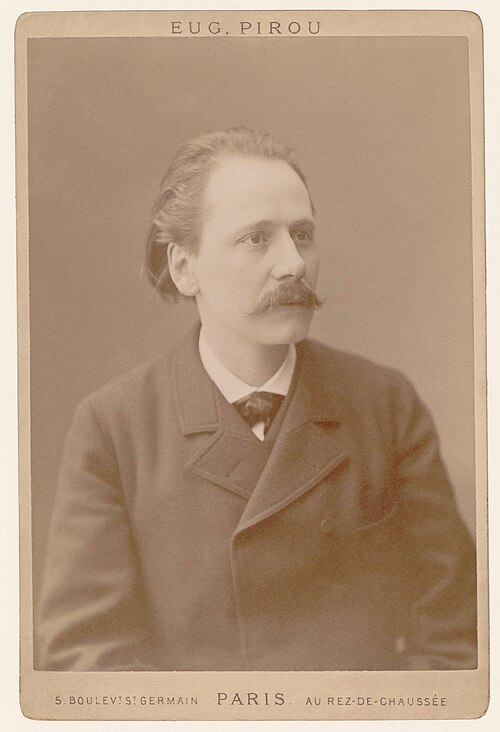

Jules Massenet
1842 — 1912
Jules Émile Frédéric Massenet was a French composer of the Romantic era best known for his operas, of which he wrote more than thirty. The two most frequently staged are Manon (1884) and Werther (1892). He also composed oratorios, ballets, orchestral works, incidental music, piano pieces, songs and other music.
Adapted from the Wikipedia article on Jules Massenet.
From the period sources
Jules Massenet, a prominent figure in the modern French school, received his training at the Paris Conservatoire, where he earned the first prize for piano in 1859, a second prize for fugue in 1862, and then both the first prize for fugue and the prestigious Prix de Rome in 1863 (Biographical Dictionary of Musicians, 1886). This coveted state prize, a three-year stipend, sent successful candidates to Rome for two years and Germany for one, requiring them to submit compositions to the Académie as proof of diligent study (Dictionary of Music, 1896). Massenet later became a Professor of Composition at the Paris Conservatoire in 1878 (Biographical Dictionary of Musicians, 1886), where he taught future notable composers such as Alfred Bruneau and Auguste-Paul-Jean-Baptiste Chapuis (A Biographical Dictionary of Musicians, 1900, 1905).
His works, “conceived in a spirit thoroughly in harmony with the advanced style of composition,” were often “elaborated and executed in a powerful dramatic manner,” with his operas considered his most representative works (Biographical Dictionary of Musicians, 1886). Indeed, his opera Le Cid (1885) was hailed as “the composer’s best work” by Cyclopedia of Music and Musicians (1888). The libretto for his opera Le portrait de Manon was penned by Georges Boyer (A Biographical Dictionary of Musicians, 1900, 1905), and his Hérodiade (1882) featured the celebrated Jean de Reszke in the role of St. John the Baptist, a performance that so pleased Massenet he secured de Reszke an engagement to create the title role in Le Cid (Grove’s Dictionary of Music and Musicians, 1922, 1908).