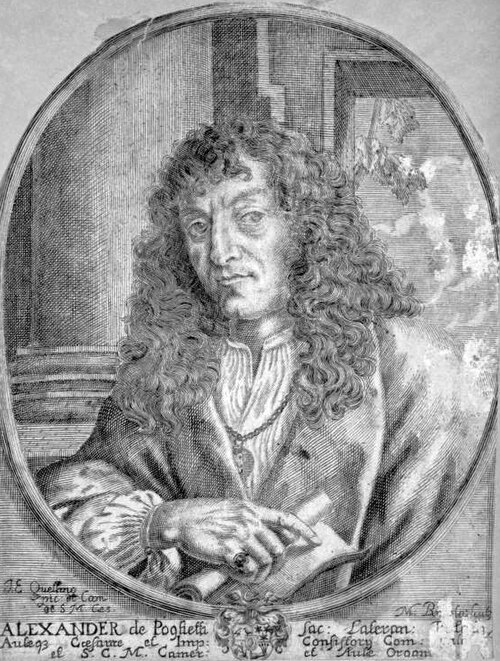

Alessandro Poglietti
Alessandro Poglietti was a Baroque organist and composer of unknown origin. In the second half of the 17th century Poglietti settled in Vienna, where he attained an extremely high reputation, becoming one of Leopold I’s favorite composers. Poglietti held the post of court organist for 22 years from 1661 until his death during the Turkish siege that led into the Battle of Vienna.
Adapted from the Wikipedia article on Alessandro Poglietti.
From the period sources
Alessandro Poglietti served as organist to the Imperial Court chapel at Vienna from 1661 until his death in 1683, when he was killed during the siege of Vienna by the Turks. His widow was granted a monthly pension by the Court upon its return in 1684, according to Grove’s Dictionary of Music and Musicians (1904). Though his origin and earlier career remain obscure, and a claim by Walther in his Lexicon that Poglietti was German by birth is deemed “highly improbable” by Grove’s, he was evidently held in high esteem at the Imperial court, as the honorary distinction “Comes Palatinus” appears with his name on his portrait and some manuscript title-pages.
Poglietti’s works, primarily for clavier and organ, circulated in manuscript during his lifetime, with none appearing in print. His most important clavier work, the extended Suite ‘Rossignolo,’ is dedicated to Empress Eleonora Magdalena Theiesia, the third wife of Emperor Leopold I, and its original autograph manuscript is described as “magnificently bound” by Grove’s (1904). This suite features twenty-three variations, many with superscriptions imitating national instruments, such as ‘Bohmisch-Dudelsack’ and ‘Ungarische Geigen,’ likely intended to symbolize the homage of various nationalities to the Emperor and Empress. Another of his suites, ‘Sopra la ribellione di Ungheria,’ is an early example of program music, referencing the 1671 rebellion and including movements titled ‘La Prisonnie’ and ‘La Sentence.’ The History of Music (1886) also identifies Poglietti as one of the renowned Italian organists whose counterpoint influenced Bach’s fugues.