_-_001.jpg)
A guide to
Jean-Philippe Rameau
Dijon 1683 — Paris 1764
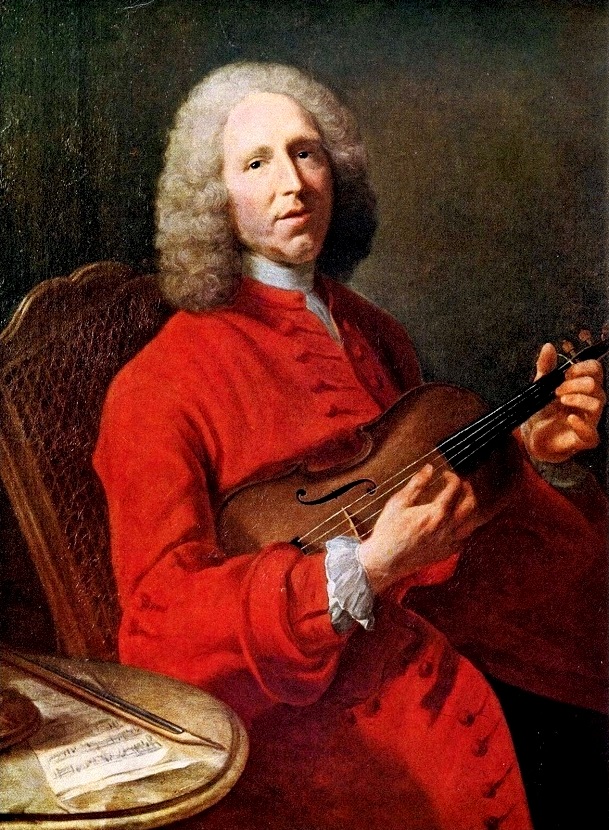
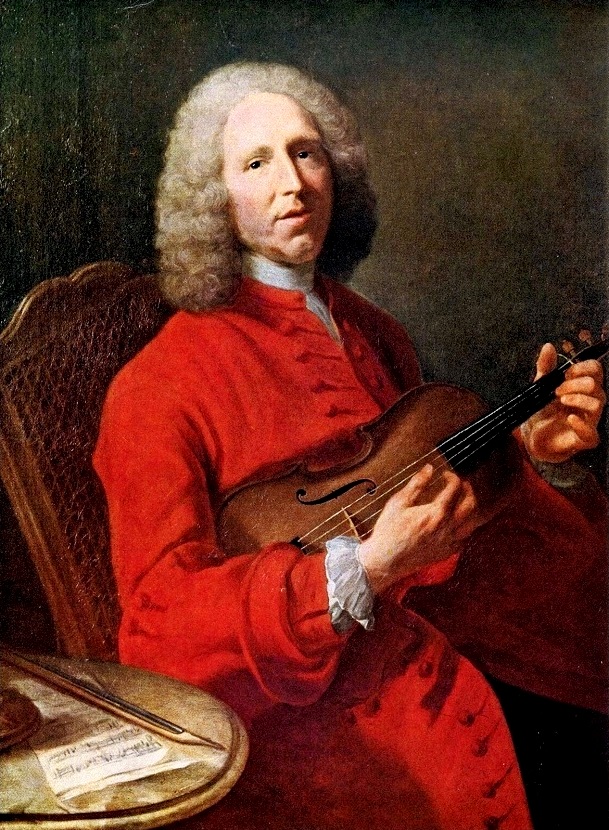
Jean-Philippe Rameau was a great composer who spent the first half of his life as an obscure provincial organist and a music theorist, and only became famous, at the very end of middle age, as the supreme opera composer of his nation. He was nearly fifty when his first opera reached the stage. Before that he had given France two things of permanent value: the foundational treatise on harmony that still underlies the way Western music is taught, and three books of harpsichord pieces that stand beside Couperin’s as the summit of the French clavecin school. The keyboard, where he began, is where the curious listener should begin too.
He was baptised in Dijon on 25 September 1683, the son of an organist, and his early career was a circuit of organ lofts — Avignon, Clermont, a return to Dijon to take over his father’s post, Lyon. He was, by every account, a difficult man: secretive, solitary, irritable, brusque with anyone who contradicted him, and prouder of his theories than of his music. “His heart and soul were in his harpsichord,” wrote his contemporary the playwright Alexis Piron; “once he had shut its lid, there was no one home.”
The Isaac Newton of music
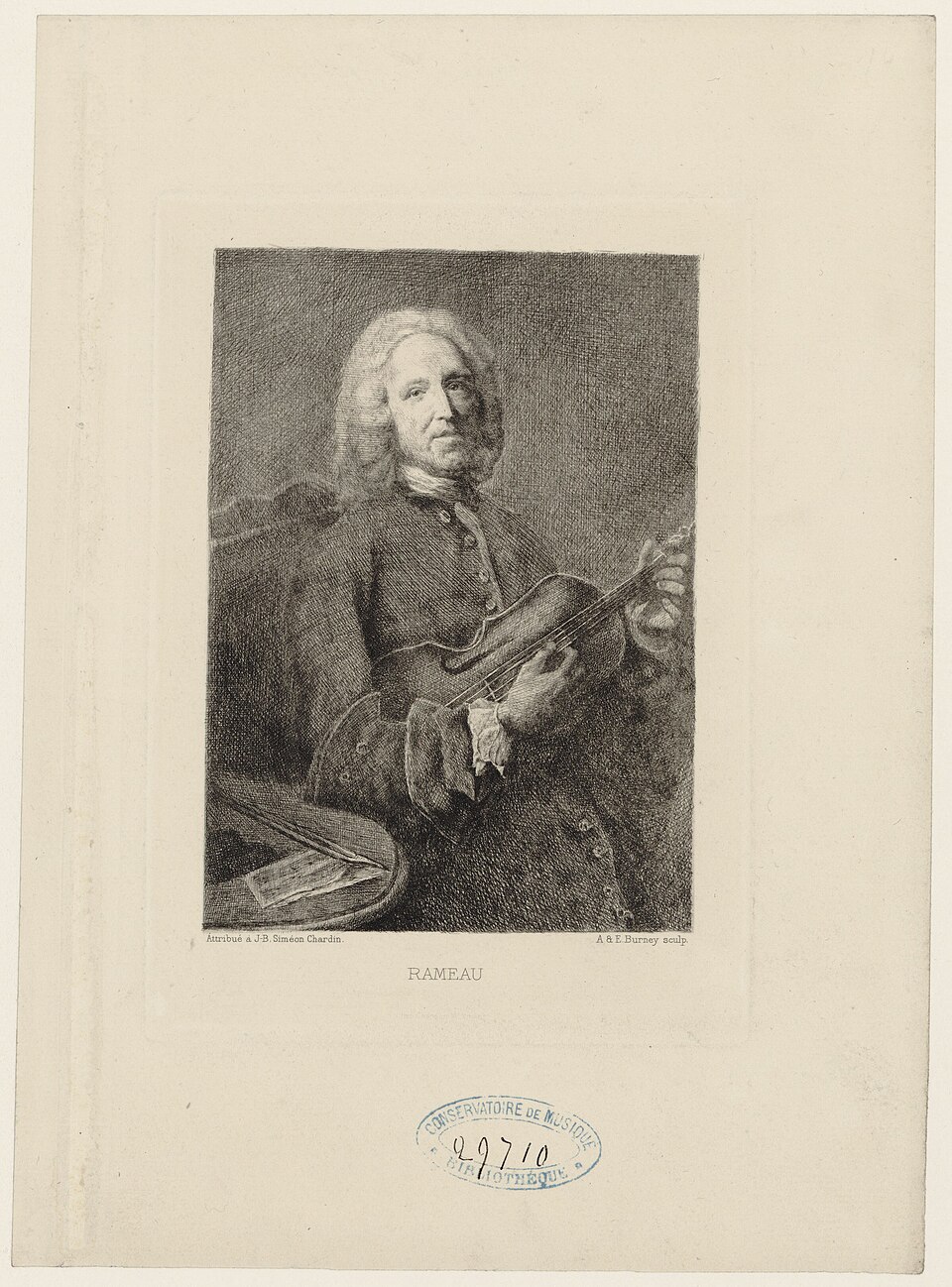
In 1722 Rameau published the Traité de l’harmonie and settled in Paris for good. The treatise initiated a revolution in music theory: it proposed the idea of the fundamental bass — the notion that a chord retains its identity through all its inversions, governed by an underlying root — and set out to explain the structure of music with the rigour of a science, blending mathematics, analysis and demonstration. So thoroughly did it recast the subject that admirers called its author “the Isaac Newton of music.” It remains, three centuries on, the foundation on which the teaching of tonal harmony rests.
His three books of harpsichord music belong to the same Parisian years. The first, from 1706, still shows the touch of his friend Louis Marchand; but the 1724 book is a masterwork — the home of Les Cyclopes, a hand-crossing showpiece of forge-hammer energy, of the delicate bird-call Le Rappel des oiseaux, and of the grave, searching L’Entretien des Muses. The later set, around 1726, gives us the strutting La Poule and the Gavotte et six doubles, a theme spun through six escalating variations. These are character pieces in the French manner, but with a harmonic daring and a keyboard brilliance that are Rameau’s alone.
The late opera composer
The turn came in 1733, when Rameau was approaching fifty and few would have predicted it. His first opera, Hippolyte et Aricie, reached the Académie Royale de Musique on 1 October, and Paris discovered that its leading theorist was also a dramatic composer of extraordinary power. He had by then found a patron in the immensely wealthy financier La Pouplinière, whose private orchestra he directed from 1731, and a sometime collaborator in Voltaire. For two decades he dominated the French operatic stage. The new music was so rich and so strange to conservative ears that audiences split into warring camps — the Lullistes against the Ramistes — and then, in the Querelle des Bouffons of 1752, the wheel turned again and Rameau, once the dangerous modernist, found himself attacked as out of date, his music dismissed as too complicated beside the easy charm of Italian comic opera.
The end
Rameau grew old unbowed but clear-eyed about his powers. “Day by day I am acquiring more good taste,” he is reported to have said late in life, “but I no longer have any genius.” He died in Paris on 12 September 1764, of a fever, thirteen days short of his eighty-first birthday. A famous story attends his deathbed: when the priest at his side tried to comfort him with a chanted prayer, the old theorist — whose ear had ordered the harmony of a nation — is said to have rebuked him with his last breath, “What the devil do you mean to sing to me, priest? You are out of tune.”
He left, among other riches, a single battered harpsichord in his rooms and a bag of gold louis no one had suspected — a fitting last paradox for a man reputed a miser who had quietly launched the career of the young organist Claude-Bénigne Balbastre and dowered his own daughter into a convent. What endures is the double legacy of the keyboard and the treatise: the harpsichord books that join Couperin’s at the heart of the French repertory, and the Traité that taught the world how to hear a chord.