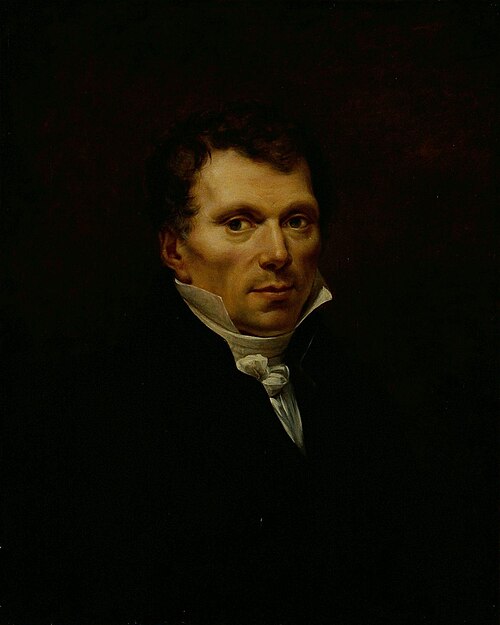
.jpg)
Anton Reicha
1770 — 1836
Anton Joseph Reicha (Rejcha) was a Bohemia-born, Bavarian-educated, later naturalized French composer and music theorist. A contemporary and friend of Beethoven, he is now best remembered for his substantial early contributions to the wind quintet literature and his role as teacher of pupils including Franz Liszt, Hector Berlioz and César Franck. He was also an accomplished theorist, and wrote several treatises on various aspects of composition. Some of his theoretical work dealt with experimental methods of composition, which he applied in a variety of works such as fugues and études for piano and string quartet.
Adapted from the Wikipedia article on Anton Reicha.
From the period sources
Anton Reicha, born in Prague on February 27, 1770, faced an early life of instability, losing his father before his first birthday and receiving insufficient education from his mother, according to Grove’s Dictionary (1922). He sought refuge with his grandfather in Glattow, Bohemia, but the limited instruction there led him to his uncle, Joseph Reicha, in Wallerstein, Bavaria. Joseph, a violoncellist, conductor, and composer who later served the Elector of Cologne at Bonn, adopted Anton with his French-speaking wife, enabling the young Reicha to learn French and German in addition to his native Bohemian, as recounted in Grove’s Dictionary (1922). At the age of nine, Anton was admitted as a choirboy at the church of the Croix-du-Seigneur, where he began his musical studies alongside Latin, later attending university (Biographie universelle, Vol. 7, 1837).
Reicha’s musical education was largely self-directed, guided by Marpurg’s treatise on fugue and Kirnberger’s work on pure composition, leading to rapid progress; at seventeen, he conducted his first symphony (Biographie universelle, Vol. 7, 1837). He later claimed that algebra was “fort utile” for understanding harmony, though Biographie universelle (Vol. 7, 1837) notes that his theoretical works prove such study “n’empêche point de tomber dans de graves erreurs.” After five years teaching piano and accompaniment in Hamburg, where he composed the French opera Godefroid de Montfort, Reicha moved to Paris in 1799, encouraged by an émigré to present his work there (Biographie universelle, Vol. 7, 1837). His symphony performed at the rue de Cléry concerts was well-received, but the closure of the Opéra-Comique theaters thwarted his operatic debut. This setback led him to Vienna, where he befriended Haydn, Albrechtsberger, Salieri, and Beethoven, and composed prolifically, demonstrating “plus de facilité que de génie” (Biographie universelle, Vol. 7, 1837). Reicha’s influence as a teacher was significant, with notable pupils including Hector Berlioz, who studied counterpoint under him at the Paris Conservatoire (Biographical Dictionary of Musicians, 1886; Cyclopedia of Music and Musicians, 1888), and Jeanne Louise Farrenc, a pianist and professor at the Conservatoire (Cyclopedia of Music and Musicians, 1889). His theoretical works, such as the “Course of Musical Composition,” were translated into English by John Bishop (Biographical Dictionary of Musicians, 1886). Reicha also experimented with rhythm, as noted in Grove’s Dictionary (1922), which highlights his 36 fugues, one of which features a quintuple time signature, reflecting a folk dance rhythm from the Lower Rhine.