
A guide to
Johann Adam Reincken
Deventer 1643 — Hamburg 1722
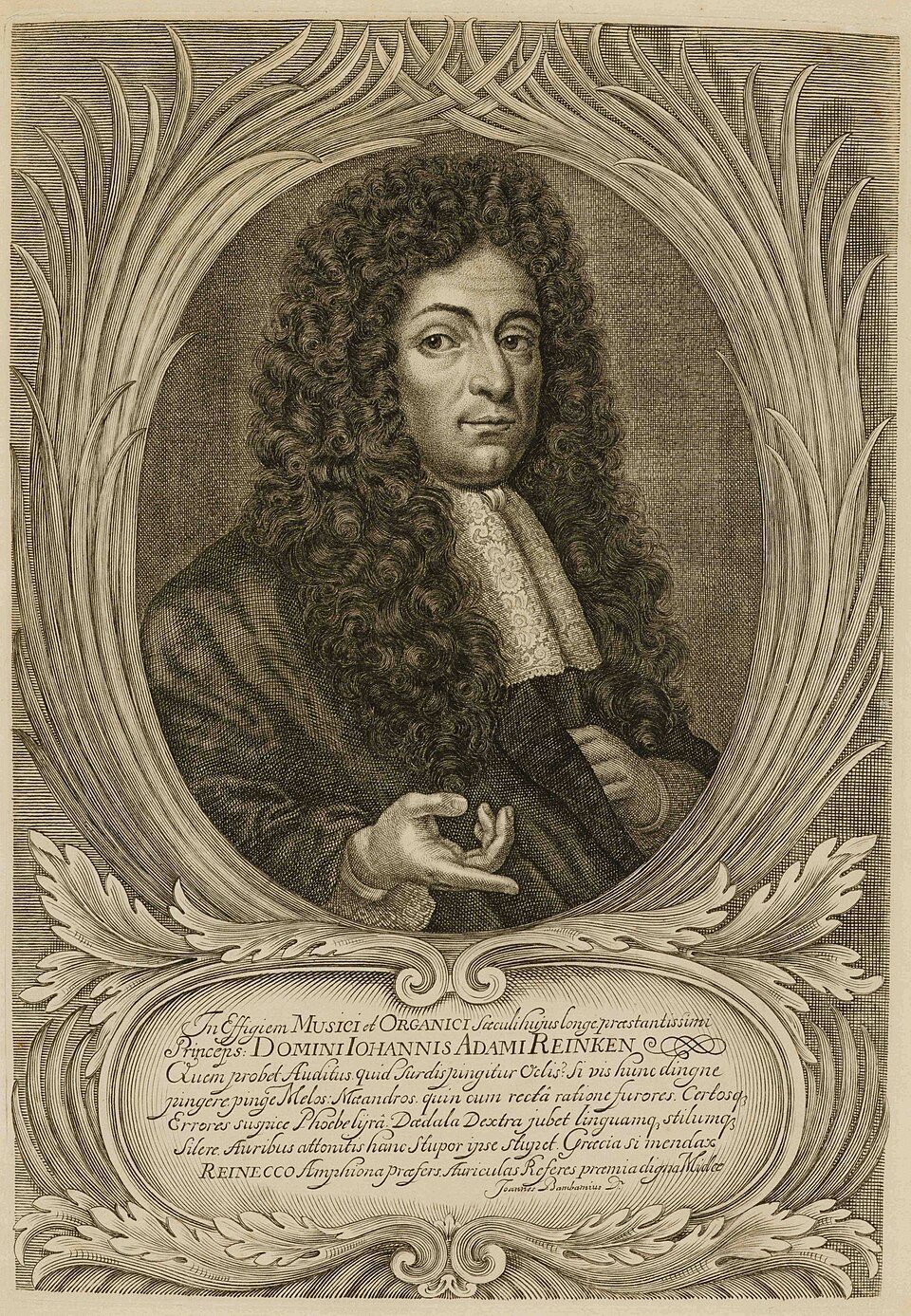
Johann Adam Reincken was the long-lived patriarch of the North German organ school — the link, in a single career of almost sixty years at one church, between the school of Sweelinck and the young Johann Sebastian Bach. He held the organ of the Catharinenkirche in Hamburg from 1663 until his death in 1722, played one of the most admired instruments in Europe, and was old enough to have been taught by a pupil of Sweelinck and to have lived to bless the rising Bach. Very little of his music survives, but it includes one of the supreme chorale fantasias of the age.
His birth is famously disputed. The contemporary writer Mattheson gave 1623, but no Deventer church record supports it; modern scholarship — chiefly the work of Ulf Grapenthin, reflected in Grove — places his baptism at Deventer in the Netherlands on 10 December 1643, the date most scholars now accept. Either way, he went to Hamburg in 1654 to study with Heinrich Scheidemann, himself a pupil of the great Sweelinck, and in 1663 he succeeded his master at the Catharinenkirche, marrying Scheidemann’s daughter two years later.
Hamburg and the famous organ
The organ of the Catharinenkirche under Reincken was one of the wonders of the age. Decades later, Bach himself could not praise it highly enough: through the testimony of J. F. Agricola (printed in Adlung’s Musica Mechanica Organoedi, 1768), we know Bach singled out the response of its thirty-two-foot Principal and Posaune in the pedals as “uniformly good and quite audible down to the lowest C,” and called the whole instrument a magnificent work of art.
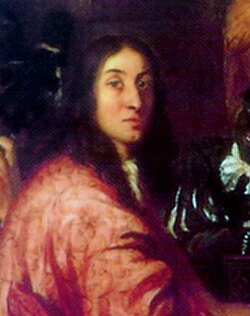
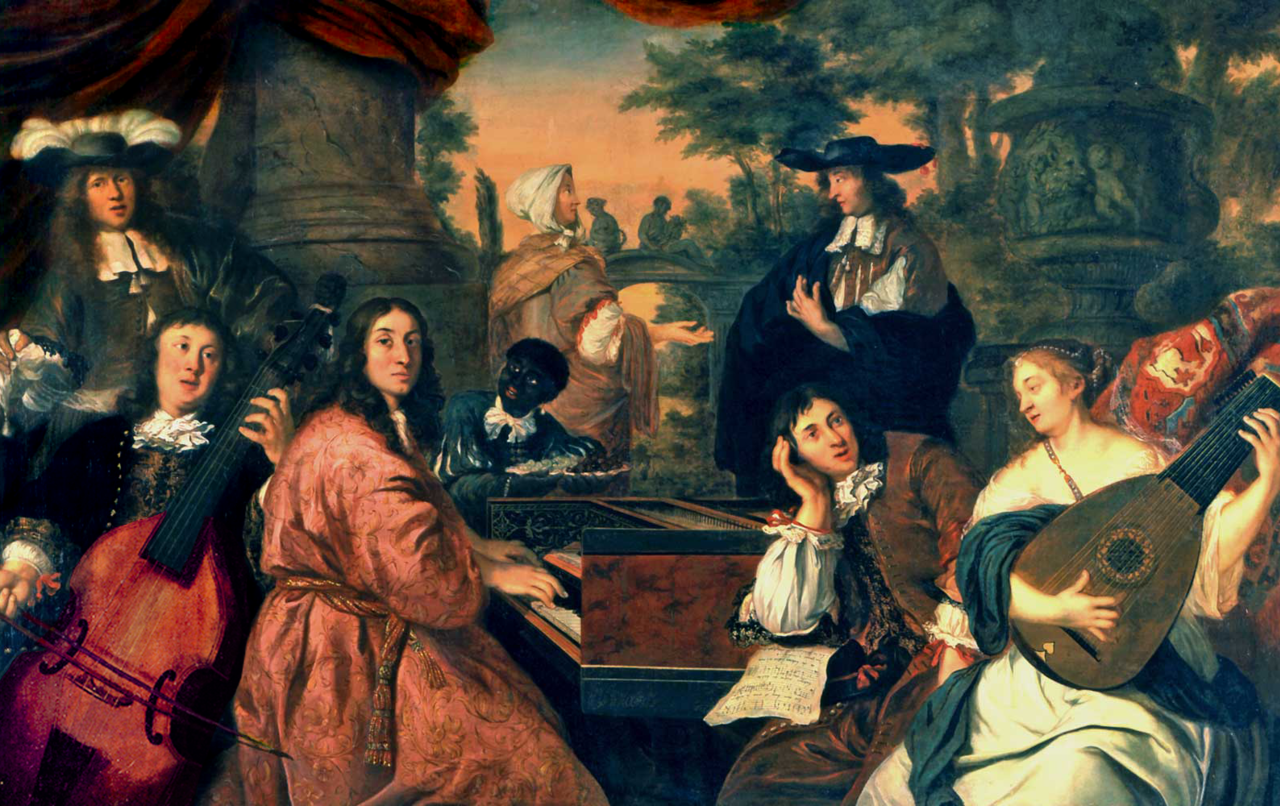
Reincken’s circle is captured in one celebrated image: Johannes Voorhout’s painting of 1674, a domestic music-making scene long thought to show Reincken at the harpsichord and his friend Buxtehude at the viola da gamba — a reading supported by a canon, written on the music in the picture, that names both men. The two organists’ friendship was famous; Buxtehude even dedicated a printed work to Reincken among others.
“I thought this art was dead”
Reincken’s gravitational pull on the young Bach is one of the great stories of music history. As a schoolboy at Lüneburg around 1700, Bach reportedly walked the thirty miles to Hamburg more than once simply to hear Reincken play. In 1700, in Georg Böhm’s house in Lüneburg, the teenaged Bach copied out Reincken’s enormous chorale fantasia An Wasserflüssen Babylon — a manuscript rediscovered in Weimar only in 2005, and now recognised as Bach’s earliest surviving autograph.
The sequel came in 1720, when Bach, by then about thirty-five, played before the aged Reincken at the Catharinenkirche and improvised for nearly half an hour on that very chorale. The episode is recorded in Bach’s obituary, the Nekrolog of 1754; the words Reincken is said to have spoken come down to us through Forkel’s biography of 1802:
I thought this art was dead, but I see that it still lives in you.
— Johann Adam Reincken to J. S. Bach, 1720, as reported by J. N. Forkel, 1802
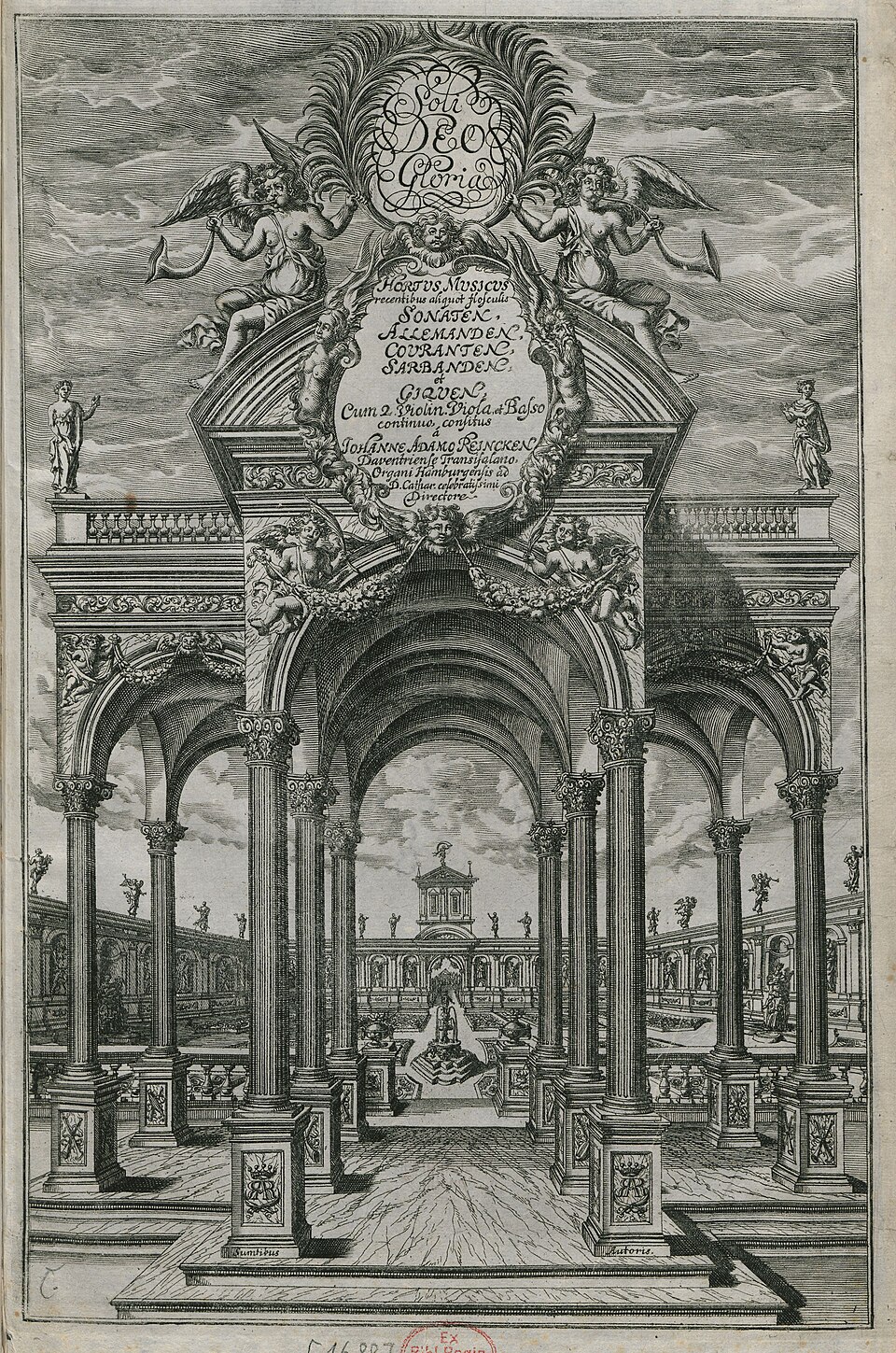
Reincken died in Hamburg on 24 November 1722, having held his post for almost six decades. His surviving works are few — the chorale fantasias, a handful of keyboard variation sets and harpsichord suites, and the Hortus Musicus of 1688, a collection of instrumental sonatas and suites that Bach also studied and arranged. Through that slender legacy, and through the line that ran from Sweelinck’s pupil’s pupil to the boy who copied his music by candlelight, Reincken stands as one of the indispensable bridges of the German Baroque.