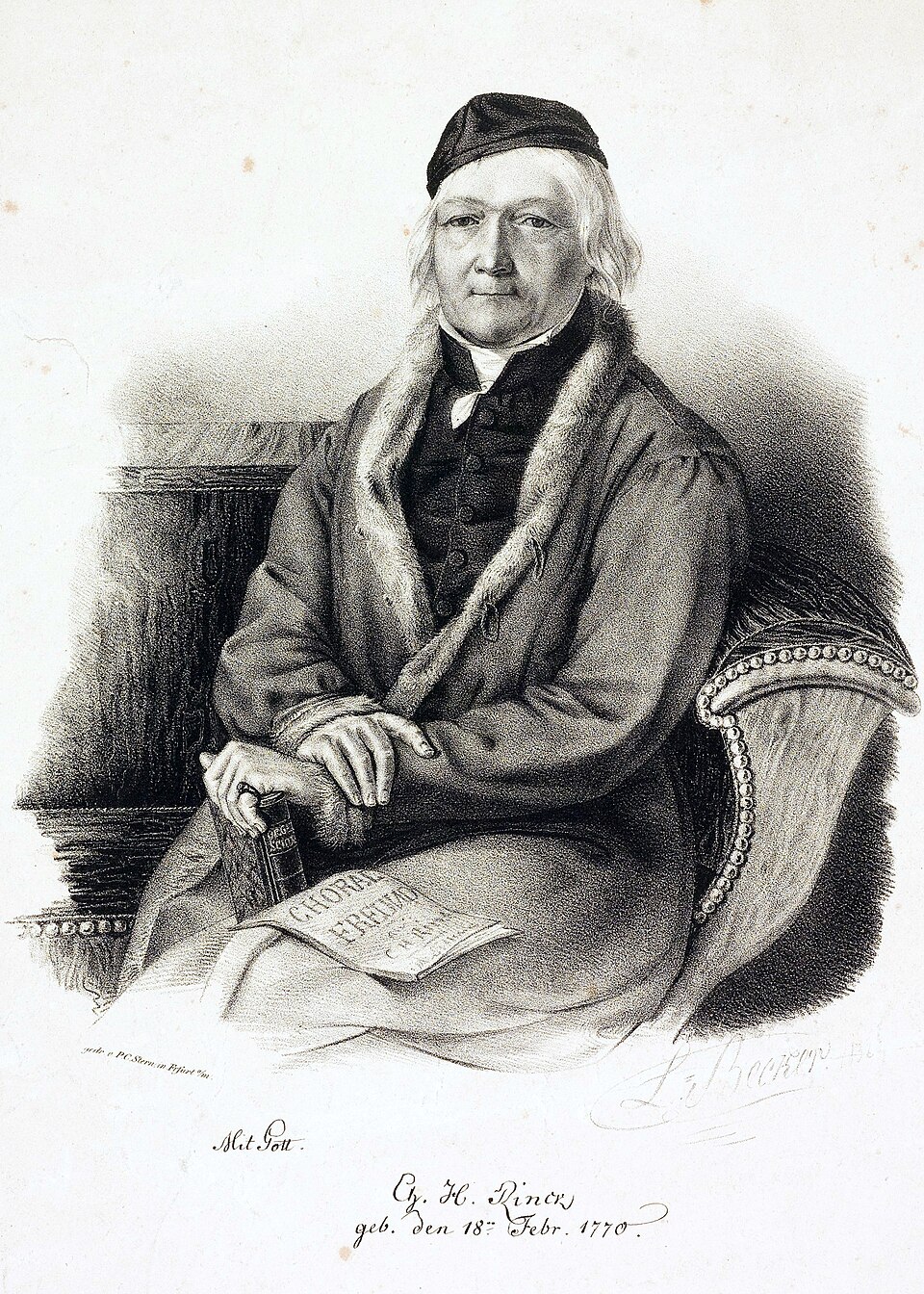
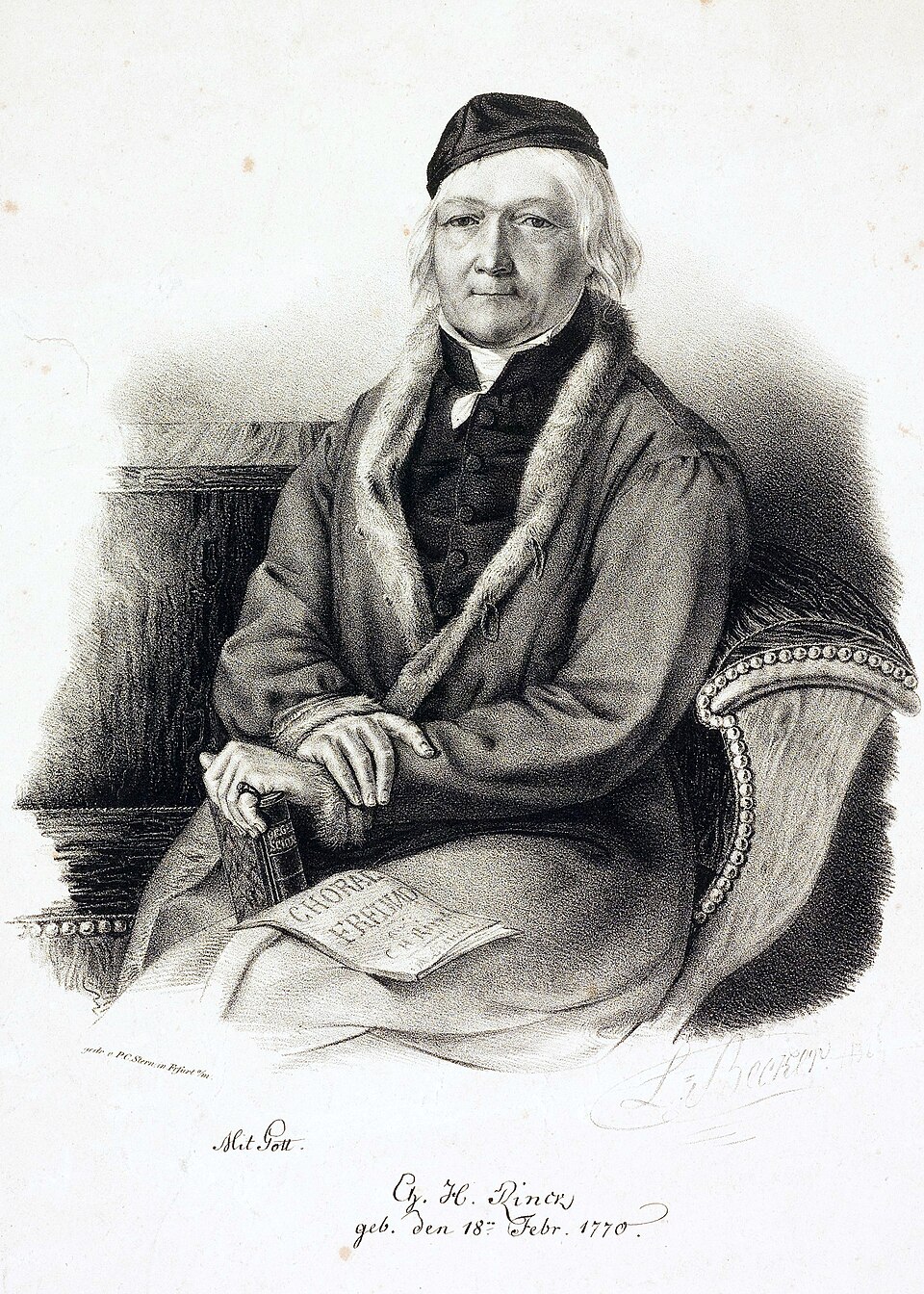
Portrait of Christian Heinrich Rinck Historical portrait · sourceHistorical portrait · Wikimedia Commons; image context in the linked biography

A guide to

Christian Heinrich Rinck

Elgersburg, Thuringia 1770 — Darmstadt 1846
  1. 1770 Born 18 February in Elgersburg, Thuringia
  2. 1786 Studies with Johann Christian Kittel in Erfurt — a pupil of J. S. Bach
  3. 1790 City organist in Gießen
  4. 1803 University Music Director in Gießen
  5. 1805 Called to Darmstadt as cantor and organist of the city church
  6. 1813 Court organist to the Grand Duke of Hesse-Darmstadt; later chamber musician
  7. 1840 Honorary doctorate from the University of Gießen
  8. 1846 Dies 7 August in Darmstadt
Lithograph portrait of Christian Heinrich Rinck
Christian Heinrich Rinck, lithograph (inscribed "geb. den 18ten Febr. 1770"). Public domain, via Wikimedia Commons.

Christian Heinrich Rinck was the great organ pedagogue of the early nineteenth century — the man whose method books and chorale preludes taught organists across Europe and America to play, and who carried the Bach tradition, hand to hand, into the Romantic age. He was born in Elgersburg, in Thuringia, on 18 February 1770, and his life joined the world of J. S. Bach to the world of Mendelssohn.

The link to Bach was almost literal. From 1786 Rinck studied in Erfurt with Johann Christian Kittel (1732–1809) — and Kittel had been one of Bach’s last pupils in Leipzig. Rinck thus received the keyboard tradition at second hand from its source, and he spent the rest of his life transmitting it. His teacher’s teacher had been Bach himself.


Gießen and Darmstadt

In 1790 Rinck took up the post of city organist in Gießen, advancing in 1803 to University Music Director there. In 1805 he was called to Darmstadt, the residence of the Grand Duchy of Hesse, as cantor and organist of the city church. From 1813 he served as court organist to the Grand Duke, later styled chamber musician — and Darmstadt remained his home for the rest of his life. The University of Gießen made him an honorary doctor in 1840, and he died in Darmstadt on 7 August 1846, in his seventy-seventh year.

He was prolific in the extreme, but it was as a teacher on paper that his name travelled. His Practische Orgelschule (Practical Organ School), Op. 55, became the most widely used organ method of the nineteenth century, reprinted and translated for decades; an organist in Boston or Leipzig might equally have learned the instrument from Rinck’s pages.


The music for use

Rinck’s enormous output — preludes, postludes, trios, variations and harmonised chorales running to well over a hundred opus numbers — was written, above all, for use. His Variations on a Theme by Corelli, Op. 56, and his many sets of chorale preludes and fugal postludes (the 12 fugirte Nachspiele, Op. 48) gave the working church organist a complete, graded repertoire of clear, well-made, idiomatic music. The collection Der Choralfreund — “the chorale’s friend” — was exactly what its title promised: a service organist’s companion.

It is fashionable to call Rinck a minor figure, and the verdict on the music’s ambition is fair enough; he wrote almost nothing for the concert recital. But the judgement misses his real importance. In an age when Bach’s organ works were still half-forgotten, Rinck kept the discipline of chorale-based playing alive and put it into the hands of a whole generation. The line he received from Kittel — and Kittel from Bach — he passed on, in print, to the organists of the Romantic century.

All works (16)

one row per PDF across every work · semicolon-delimited

Undated works follow in catalogue order.Filter these works →

CatalogTitleInstrumentation
Op20 Organ Trios
Open individual scores (1)PDF on IMSLP ↗IMSLP work page ↗
Orgel 1 PDF Spotify Apple Music
Op37 40 Kleine, leichte und vermischte Orgelpräludien
Open individual scores (1)PDF on IMSLP ↗IMSLP work page ↗
Orgel 1 PDF Spotify Apple Music
Op48 12 fugirte Nachspiele für Orgel
Open individual scores (1)PDF on IMSLP ↗IMSLP work page ↗
Orgel solo 1 PDF Spotify Apple Music
Op55 Practische Orgelschule
Open individual scores (1)PDF on IMSLP ↗IMSLP work page ↗
Orgel MIDI1 PDF Spotify Apple Music
Op56 Variations on a Theme by Corelli
Open individual scores (1)PDF on IMSLP ↗IMSLP work page ↗
Orgel 1 PDF Spotify Apple Music
Op57 12 Adagios for Organ
Open individual scores (1)PDF on IMSLP ↗IMSLP work page ↗
Orgel MIDI1 PDF Spotify Apple Music
Op70 8 Variations on an Andante
Open individual scores (1)PDF on IMSLP ↗IMSLP work page ↗
Orgel 1 PDF Spotify Apple Music
Op77 6 Choräle
Open individual scores (1)PDF on IMSLP ↗IMSLP work page ↗
Orgel 1 PDF Spotify Apple Music
Op104 Der Choralfreund, Jahrgang 2
Open individual scores (1)PDF on IMSLP ↗IMSLP work page ↗
Orgel 1 PDF Spotify Apple Music
Op110 Der Choralfreund, Jahrgang 3
Open individual scores (1)PDF on IMSLP ↗IMSLP work page ↗
Orgel 1 PDF Spotify Apple Music
105 Organ Preludes
Open individual scores (1)PDF on IMSLP ↗IMSLP work page ↗
Orgel 1 PDF Spotify Apple Music
2 Preludes
Open individual scores (1)PDF on IMSLP ↗IMSLP work page ↗
Orgel 1 PDF Spotify Apple Music
8 Orgelstücke
Open individual scores (1)PDF on IMSLP ↗IMSLP work page ↗
Orgel 1 PDF Spotify Apple Music
Adagio in A minor
Open individual scores (1)PDF on IMSLP ↗IMSLP work page ↗
Tasteninstrument 1 PDF Spotify Apple Music
Trio in G major
Open individual scores (1)PDF on IMSLP ↗IMSLP work page ↗
Orgel 1 PDF Spotify Apple Music
Élévation - Prélude
Open individual scores (1)PDF on IMSLP ↗IMSLP work page ↗
Orgel, Harmonium MIDI1 PDF Spotify Apple Music