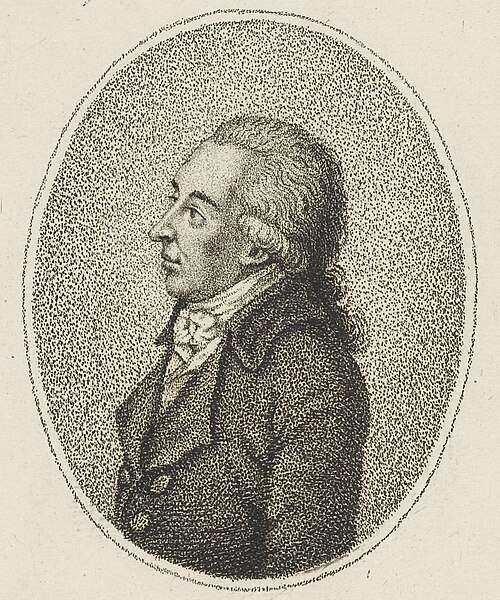

Friedrich Wilhelm Rust
1739 — 1796
Friedrich Wilhelm Rust was a German violinist, pianist and composer. He hailed from a renowned musical family in Germany. He was the father of the pianist and organist Wilhelm Karl Rust and the grandfather of Thomaskantor, composer and Bach scholar Wilhelm Rust.
Adapted from the Wikipedia article on Friedrich Wilhelm Rust.
From the period sources
Friedrich Wilhelm Rust, born in Wörlitz, near Dessau, in 1739, displayed remarkable musical precocity, reportedly playing the violin and harpsichord from the age of six without formal instruction, and by thirteen, could perform the entirety of Bach’s Wohltemperirtes Clavier from memory (Grove’s Dictionary, 1908). His extensive education included composition, organ, and clavier studies with Friedemann and Emanuel Bach, and violin with Hockh and F. Benda. A journey to Italy in 1765 further enriched his training, where he studied with G. Benda, Tartini, and Pugnani.
Returning to Dessau in 1766, Rust became a central figure in the local music scene, eventually being appointed music-director of a new theatre opened through his efforts in 1774 (Grove’s Dictionary, 1908). He married his pupil, Henriette Niedhart, a noted singer, and his life remained largely confined to Dessau, with occasional visits to Berlin and Dresden. His compositions included operas, cantatas, duodramas, monodramas, and music for plays, alongside numerous odes, songs, sonatas, variations, concertos, and fugues for pianoforte, and three sonatas for solo violin. According to Grove’s Dictionary (1908), these violin sonatas, republished by his grandson, were the only works by which he was known at the time of the dictionary’s publication. Rust also taught composition, with the poet Frédéric-Guillaume Rosenfeld among his pupils in Dessau (Biographie universelle des musiciens, 1866). His son, Wilhelm Carl Rust, born in Dessau in 1787, later became acquainted with Beethoven in Vienna.