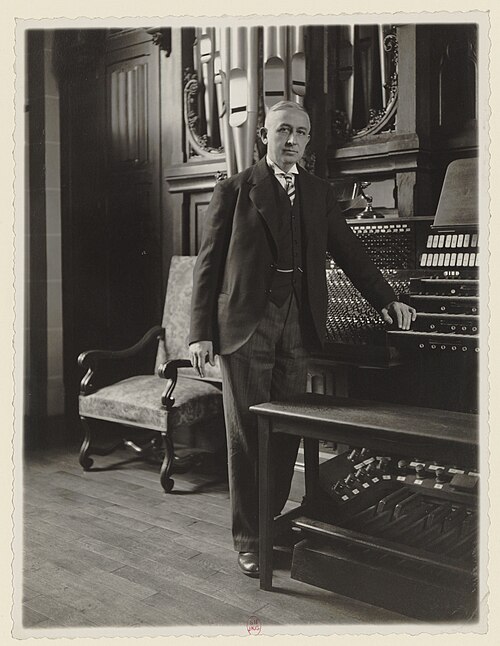
Portrait of Marcel Dupré Historical portrait · sourcePhotographer unidentified · Bibliothèque nationale de France, Est.DupréM.027 · Public domain (Commons PD-France)

A guide to

Marcel Dupré

Rouen 1886 — Meudon 1971
  1. 1886 Born in Rouen, 3 May, into a family of organists
  2. 1904 Enters the Paris Conservatoire (Guilmant, Vierne, Widor)
  3. 1914 Wins the Prix de Rome with the cantata Psyché
  4. 1920 Plays Bach's complete organ works from memory in ten recitals
  5. 1921 American debut at the Wanamaker organ, New York; improvises in Philadelphia
  6. 1926 Appointed professor of organ at the Paris Conservatoire
  7. 1934 Succeeds Widor as organist of Saint-Sulpice
  8. 1954 Director of the Paris Conservatoire; dies at Meudon in 1971
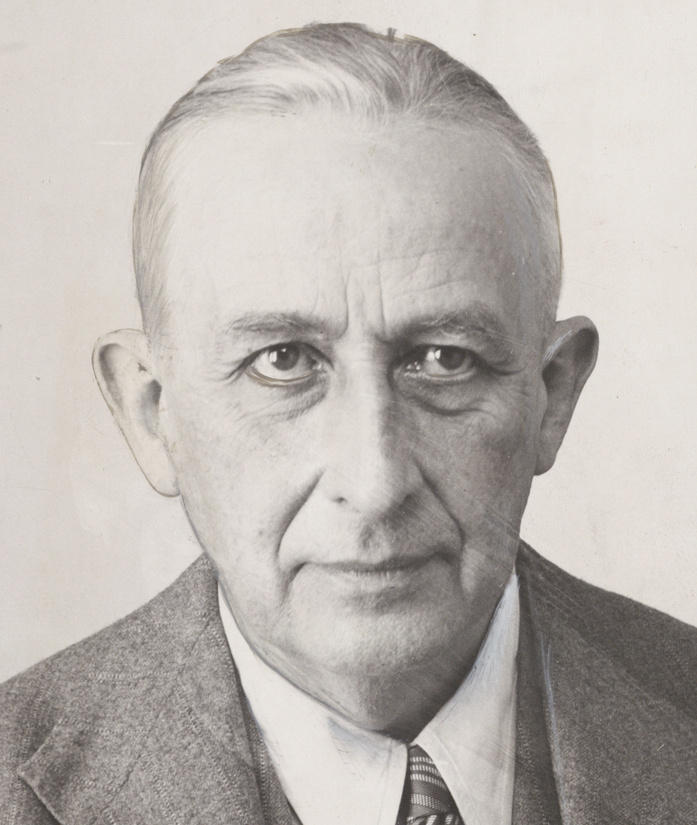
Marcel Dupré
Marcel Dupré (1886–1971). Photograph, public domain, via Wikimedia Commons.

Marcel Dupré was the supreme virtuoso of the organ in the twentieth century — a player whose technique and memory were so far beyond the ordinary that the French press, which had no shortage of superlatives, settled on calling him “the Paganini of the organ.” He could play the complete organ works of Bach from memory; he could improvise, on themes shouted up from a concert hall, a four-movement symphony that observers took for a written masterpiece. He gave more than two thousand recitals across four continents. And for thirty-seven years he held the bench at Saint-Sulpice that his teacher Widor had held before him, so that the great organ of that church passed through only two pairs of hands in the better part of a century.

He was born in Rouen on 3 May 1886 into a family steeped in the instrument. His father, Albert Dupré, was titular organist of the Abbey of Saint-Ouen and, like his own father before him, a friend of the builder Aristide Cavaillé-Coll. When Marcel was ten, a Cavaillé-Coll organ was installed in the family house. He entered the Paris Conservatoire in 1904, studying organ with Alexandre Guilmant and Louis Vierne, and fugue and composition with Charles-Marie Widor; in 1914 he crowned his Conservatoire years by winning the Prix de Rome with the cantata Psyché.


The complete Bach, from memory
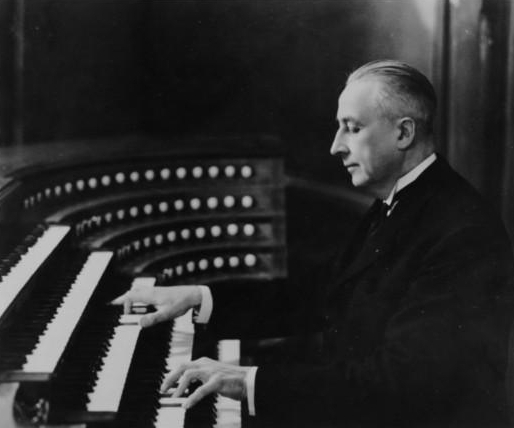
Marcel Dupré at the organ of Saint-Sulpice
Marcel Dupré at the console of the great Cavaillé-Coll organ of Saint-Sulpice, Paris — the instrument he inherited from Widor in 1934 and held until his death. Public domain, via Wikimedia Commons.

The feat that made his name was an act of memory. In 1920 Dupré played the complete organ works of Johann Sebastian Bach in ten recitals — entirely from memory — at the Paris Conservatoire, and repeated the cycle the following year at the Palais du Trocadéro. Nothing on that scale had been attempted; it announced a player for whom the entire central repertory of the instrument was simply held in the head, ready to hand.

The Bach cycle was the foundation of a strict, lucid musicianship translated to the pedalboard. Widor had pronounced two of the Trois Préludes et Fugues, Op. 7, “unplayable,” and for years Dupré was the only organist who could play them in public — a small token of the gap between his technique and everyone else’s.


America and the great improvisations

In November 1921 Dupré made his American debut on the famous organ of the Wanamaker department store in New York, closing the recital with an improvised four-movement organ symphony that one newspaper called “A Musical Miracle.” The Wanamaker firm sponsored tour after tour — ninety-four concerts in 1922, a hundred and ten in 1923 — and America made his international reputation.

It was in Philadelphia, in the Christmas season of 1921, that improvisation became composition. Handed four themes by the audience — among them Adeste fideles and the Stabat mater — Dupré improvised a continuous work in four movements running from Advent to Easter. He afterwards wrote it down as the Symphonie-Passion, Op. 23, published in 1924. A decade later he did the same with the Stations of the Cross: invited to improvise between readings of Paul Claudel’s poetic Chemin de la Croix, he played, in February 1931, fourteen meditations of such weight that he set them down as Op. 29, one of the monuments of the French organ literature. With Dupré, the line between improvising and composing all but disappeared.


Saint-Sulpice, the Conservatoire, the succession
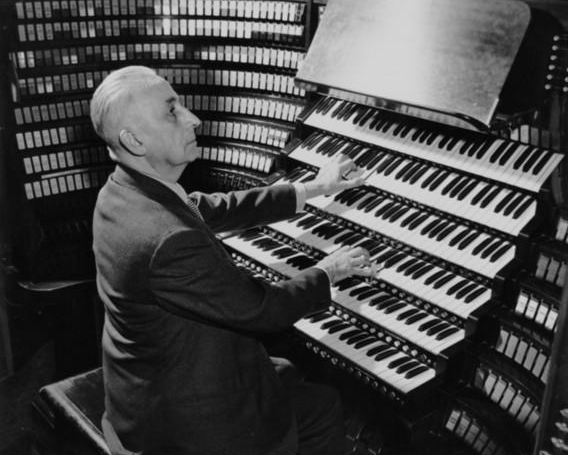
Marcel Dupré at the Wanamaker organ in Philadelphia
Marcel Dupré at the console of the colossal Wanamaker organ in Philadelphia, where in 1921 he improvised the work he would publish as the *Symphonie-Passion*. Public domain, via Wikimedia Commons.

In 1934 Dupré succeeded Widor as organist of Saint-Sulpice, holding the post until his death — so that, across the long tenures of master and pupil, the bench changed hands only once in a century. He was professor of organ at the Paris Conservatoire from 1926, and finally its director from 1954 to 1956. As a teacher he was as consequential as his playing: his class produced Olivier Messiaen, Jehan Alain and his sister Marie-Claire Alain, Jeanne Demessieux, Jean Langlais, and Pierre Cochereau, among the most important French organists of the age. His treatises on improvisation became the standard manuals of the discipline.

He died on Pentecost Sunday, 30 May 1971, at his home in Meudon. He had played the morning Mass at Saint-Sulpice that very day, lunched at home, and died that evening — a working organist to the last hour, at the keyboard of the church he had served for thirty-seven years.

All works (28)

one row per PDF across every work · semicolon-delimited

Undated works follow in catalogue order.Filter these works →

CatalogTitleInstrumentation
Op7 3 Preludes and Fugues
Open individual scores (1)PDF on IMSLP ↗IMSLP work page ↗
1 PDF Spotify Apple Music
Op12 6 Préludes
Open individual scores (1)PDF on IMSLP ↗IMSLP work page ↗
1 PDF Spotify Apple Music
Op16 Scherzo
Open individual scores (1)PDF on IMSLP ↗IMSLP work page ↗
1 PDF Spotify Apple Music
Op18 Vêpres du commun des fêtes de la Sainte Vierge
Open individual scores (1)PDF on IMSLP ↗IMSLP work page ↗
1 PDF Spotify Apple Music
Op19 4 Pièces
Open individual scores (4)PDF on IMSLP ↗IMSLP work page ↗PDF on IMSLP ↗IMSLP work page ↗PDF on IMSLP ↗IMSLP work page ↗PDF on IMSLP ↗IMSLP work page ↗
4 PDFs Spotify Apple Music
Op20 Variations sur un Noël
Open individual scores (1)PDF on IMSLP ↗IMSLP work page ↗
1 PDF Spotify Apple Music
Op21 Suite bretonne
Open individual scores (1)PDF on IMSLP ↗IMSLP work page ↗
1 PDF Spotify Apple Music
Op23 Symphonie-Passion
Open individual scores (1)PDF on IMSLP ↗IMSLP work page ↗
1 PDF Spotify Apple Music
Op24 Lamento
Open individual scores (1)PDF on IMSLP ↗IMSLP work page ↗
1 PDF Spotify Apple Music
Op26 Organ Symphony No.2
Open individual scores (1)PDF on IMSLP ↗IMSLP work page ↗
1 PDF Spotify Apple Music
Op27 7 Pieces
Open individual scores (1)PDF on IMSLP ↗IMSLP work page ↗
1 PDF Spotify Apple Music
Op28 79 Chorales
Open individual scores (1)PDF on IMSLP ↗IMSLP work page ↗
1 PDF Spotify Apple Music
Op29 Le Chemin de la Croix
Open individual scores (1)PDF on IMSLP ↗IMSLP work page ↗
1 PDF Spotify Apple Music
Op36 3 Preludes and Fugues
Open individual scores (1)PDF on IMSLP ↗IMSLP work page ↗
1 PDF Spotify Apple Music
Op38 Le Tombeau de Titelouze
Open individual scores (1)PDF on IMSLP ↗IMSLP work page ↗
1 PDF Spotify Apple Music
Op39 Suite for Organ
Open individual scores (1)PDF on IMSLP ↗IMSLP work page ↗
1 PDF Spotify Apple Music
Op40 Offrande à la Vierge
Open individual scores (1)PDF on IMSLP ↗IMSLP work page ↗
1 PDF Spotify Apple Music
Op41 Esquisses
Open individual scores (1)PDF on IMSLP ↗IMSLP work page ↗
1 PDF Spotify Apple Music
Op44 Vision
Open individual scores (1)PDF on IMSLP ↗IMSLP work page ↗
1 PDF Spotify Apple Music
Op45 8 Short Preludes on Gregorian Themes
Open individual scores (1)PDF on IMSLP ↗IMSLP work page ↗
1 PDF Spotify Apple Music
Op48 6 Antiennes pour le Temps de Noël
Open individual scores (1)PDF on IMSLP ↗IMSLP work page ↗
1 PDF Spotify Apple Music
Op50 24 Inventions
Open individual scores (1)PDF on IMSLP ↗IMSLP work page ↗
1 PDF Spotify Apple Music
Op56 Annonciation
Open individual scores (1)PDF on IMSLP ↗IMSLP work page ↗
1 PDF Spotify Apple Music
Op57 Choral et fugue
Open individual scores (1)PDF on IMSLP ↗IMSLP work page ↗
1 PDF Spotify Apple Music
Op61 In Memoriam
Open individual scores (1)PDF on IMSLP ↗IMSLP work page ↗
1 PDF Spotify Apple Music
Op63 4 Fugues modales
Open individual scores (1)PDF on IMSLP ↗IMSLP work page ↗
1 PDF Spotify Apple Music
Méthode d'orgue
Open individual scores (1)PDF on IMSLP ↗IMSLP work page ↗
1 PDF Spotify Apple Music
Traité d'Improvisation à l'Orgue
Open individual scores (1)PDF on IMSLP ↗IMSLP work page ↗
1 PDF Spotify Apple Music