A guide to
Franz Tunder
Lübeck (or Fehmarn) 1614 — Lübeck 1667
Franz Tunder stands at the head of the great North German organ tradition — the man whose post at Lübeck’s Marienkirche, whose concert series, and even whose daughter passed directly to Dieterich Buxtehude. He was born in 1614, probably in Lübeck itself, though older accounts place his birth on the island of Fehmarn. By 1632 he was court organist at Gottorf, in the service of Frederick III, Duke of Holstein-Gottorp. No likeness of him survives, and only a handful of his works do — yet his shadow falls across everything that followed in the north.
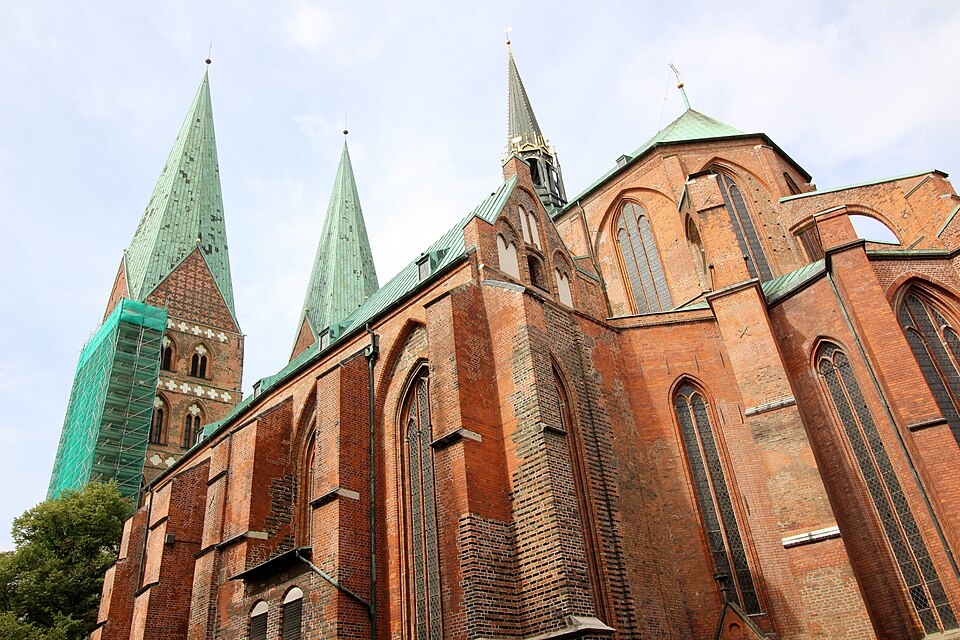
The decisive appointment came in 1641, when he succeeded Peter Hasse as organist of the Marienkirche in Lübeck, one of the most prestigious organ posts in northern Europe. He held it for the rest of his life, and in 1647 took on in addition the church’s administrative office of Werkmeister, or treasurer — an unusual double role that made him both its leading musician and one of its officials.
The Abendmusik
Tunder’s most lasting institutional legacy was the Abendmusik — the “evening music,” a series of free public concerts held in the Marienkirche. The earliest documented performance dates from 1646. These began, by tradition, as organ recitals given for the city’s businessmen around the opening of the stock exchange, financed by the merchant community and open to all without charge. Under Tunder they grew into something larger, drawing in voices and instruments; under his successor Buxtehude they would become the celebrated Advent oratorio concerts that drew the young J. S. Bach to walk to Lübeck.
The continuity from Tunder to Buxtehude was total. When Tunder died on 5 November 1667, Buxtehude was appointed in his place — and the following year, 1668, married Tunder’s daughter Anna Margarethe, just as Buxtehude himself would later require his own successor to marry his daughter. The Lübeck organ bench passed, for the better part of a century, almost as a family inheritance.
The surviving music
For a musician of such standing, astonishingly little of Tunder’s work has come down to us. There survive about a dozen and a half vocal concertos and cantatas — among the earliest fully developed examples of the German chorale cantata, a form he was instrumental in shaping — and a small body of organ music: free praeludia in the stylus phantasticus, a few fugues, and chorale settings such as Jesus Christus unser Heiland, several of which open with the bold pedal flourish that became a signature of the North German school.
That organ music shows Tunder as a transitional figure of the first importance. He is the bridge between the early German Baroque — rooted in Venetian models, and possibly, as Johann Mattheson later claimed, in study with Frescobaldi in Italy (a connection modern scholars treat with caution) — and the mature North German style that runs forward through Buxtehude and Bruhns to Bach. He gave that tradition its Lübeck home, its concert platform, and its first great organ chair; the music that survives is a fragment of what must have filled the Marienkirche on those evenings.